 Kanata's Japan Shrine Guide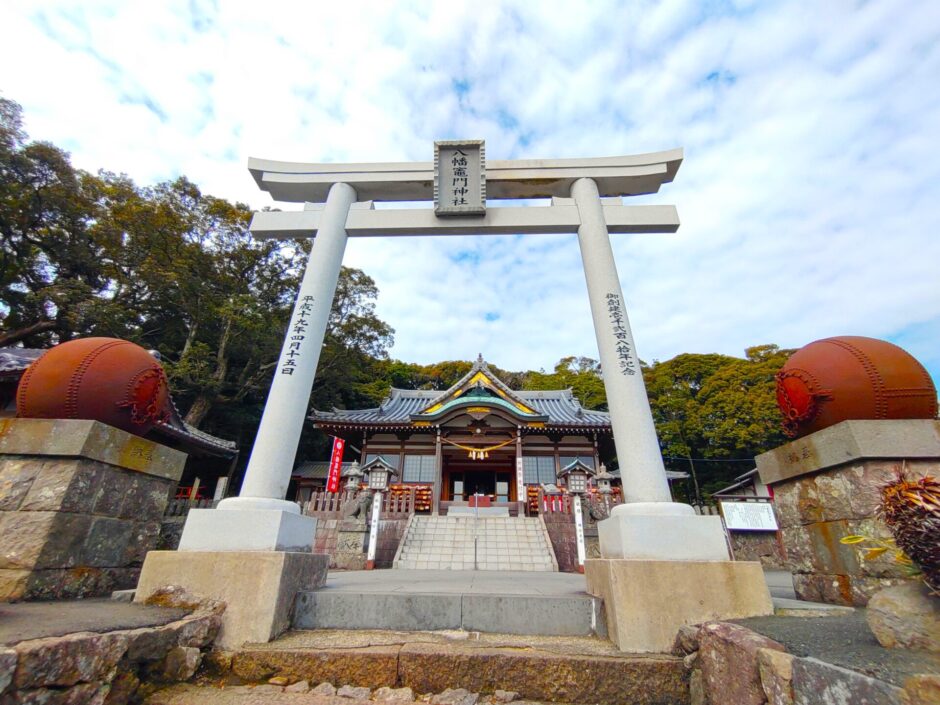

目次
- 【Overview of Hachiman Kamado Shrine】
- 【Hachiman Kamado Shrine Approach】
- 【Hachiman Kamado Shrine Koma-Kirai (Guardian Naval Mine)】
- 【Hachiman Kamado Shrine Nade-Kame (Sacred Stroking Turtle)】
- 【Hachiman Kamado Shrine Buildings】
- 【Hachiman Kamado Shrine Worship Hall: The Dragon Painting】
- 【Hachiman Kamado Shrine: A Demon Slayer Holy Site?】
- 【Hachiman Kamado Shrine Sacred Tree】
- 【The Stone Sandal Left by the Demon】
- 【Nearby Tourist Spots】
- 【Hachiman Kamado Shrine Access】
- Admin’s Impressions
- Hachiman Kamado Shrine Address
- Hachiman Kamado Shrine Official Website
【Overview of Hachiman Kamado Shrine】
Hachiman Kamado Shrine was founded in the year 727 AD (Jinki 4).
According to the shrine’s historical records, its origins date back to the reign of Emperor Nintoku (312–399 AD). When Yamato Takeru no Mikoto and Empress Jingu embarked on their western expedition, they established a temporary imperial palace (Angu) in Kamado-no-sho Kameyama and enshrined 33 deities, including Kunitokotachi no Mikoto and Amaterasu Omikami. On March 15 in the 4th year of the Jinki era (727 AD), the divine spirits of Emperor Chuai and Emperor Ojin are said to have descended from Usa in Buzen Province to Kamado-no-sho Hojomine, later relocating to Mount Mikoshi and being enshrined at Kamado-no-miya. Consequently, the year 727 AD is officially recognized as the year of its founding.
The primary enshrined deities are Emperor Ojin, Emperor Chuai, and Empress Jingu, alongside 33 other deities including Kunitokotachi no Mikoto and Amaterasu Omikami.
【Hachiman Kamado Shrine Approach】
![DSC 3155 1024x768 - Hachiman Kamado Shrine [Oita]](https://japan-shrine.info/wp-content/uploads/DSC_3155-1024x768.jpg "Hachiman Kamado Shrine [Oita]")
Along Prefectural Road 218, you will find a set of stone steps and the Ichi-no-Torii (First Torii Gate). These stairs are the very steps said to have been built by the demon. They actually look much more neatly constructed than expected… Once you climb to the top, the Ni-no-Torii (Second Torii Gate) and the shrine buildings come into view.
【Hachiman Kamado Shrine Koma-Kirai (Guardian Naval Mine)】
![DSC 3144 1024x768 - Hachiman Kamado Shrine [Oita]](https://japan-shrine.info/wp-content/uploads/DSC_3144-1024x768.jpg "Hachiman Kamado Shrine [Oita]")
On both sides of the torii gate sit giant iron spheres. Since a naval base was located nearby, these underwater weapons were dedicated to the shrine to commemorate the victory in the Shinano-German War (World War I).
【Hachiman Kamado Shrine Nade-Kame (Sacred Stroking Turtle)】
A statue of a turtle rests in front of the worship hall. This is not just a simple ornament; every year, the hands of craftsmen and Shinto priests carefully shift its direction bit by bit to align precisely with the Eho—the luckiest direction of that specific year. It is believed that if you stroke the body of the turtle and pray for good fortune, family safety, prosperity, and longevity, your wishes will come true.
![DSC 3152 1024x768 - Hachiman Kamado Shrine [Oita]](https://japan-shrine.info/wp-content/uploads/DSC_3152-1024x768.jpg "Hachiman Kamado Shrine [Oita]")
Although the shrine itself was founded in 727 AD (Jinki 4), the small hill upon which it sits has been called “Kameyama” (Turtle Mountain) since ancient times. In the 15th year of the Jowa era (848 AD) during the Heian period, an extremely rare “white turtle” was captured in a local river and presented to the Imperial Court (Emperor Ninmyo). The Emperor was so overjoyed, viewing this as a magnificent auspicious omen (Kiccho) for national prosperity, that he changed the official era name to “Kasho.” This legend also serves as the origin for the name of the surrounding area, “Kamegawa” (Turtle River). Because the shrine itself shares such a deep bond with turtles, this statue was created as a symbol of good luck.
【Hachiman Kamado Shrine Buildings】
![DSC 3153 1024x768 - Hachiman Kamado Shrine [Oita]](https://japan-shrine.info/wp-content/uploads/DSC_3153-1024x768.jpg "Hachiman Kamado Shrine [Oita]")
Reaching the top of the 99 stone steps reveals a grand and impressive shrine complex. According to historical cultural asset surveys of Beppu City, official records submitted to the Kokura Domain (the Ogasawara clan), who were the ruling lords at the time, survive from the 3rd year of the Kanpo era (1743) during the Edo period. These records indicate that long before the current structures (built in 1906 and 1963) were erected, a magnificent shrine complex with almost the exact same layout existed on this very land.
While the physical structures standing today are modern reconstructions, the fundamental layout of enshrining the deities within a main hall (Honden) and a worship hall (Haiden) has been documented in ancient texts for hundreds of years and carefully preserved through the generations.
【Hachiman Kamado Shrine Worship Hall: The Dragon Painting】
![DSC 3137 1024x768 - Hachiman Kamado Shrine [Oita]](https://japan-shrine.info/wp-content/uploads/DSC_3137-1024x768.jpg "Hachiman Kamado Shrine [Oita]")
The ceiling painting inside the worship hall features a spectacular ink-wash painting of a dragon. Depicting a water deity (Suijin-sama), it is believed to protect the shrine from fires.
![DSC 3136 1024x768 - Hachiman Kamado Shrine [Oita]](https://japan-shrine.info/wp-content/uploads/DSC_3136-1024x768.jpg "Hachiman Kamado Shrine [Oita]")
The imagery strongly evokes the Water Breathing, Tenth Form: Constant Flux (Mizu no Kokyu, Ju no Kata: Seisei Ruten) technique used by Tanjiro Kamado in Demon Slayer, suggesting the author may have used it as a reference.
【Hachiman Kamado Shrine: A Demon Slayer Holy Site?】
![demonslayer 001 - Hachiman Kamado Shrine [Oita]](https://japan-shrine.info/wp-content/uploads/demonslayer-001.jpg "Hachiman Kamado Shrine [Oita]")
The shrine has drawn massive attention as a pop-culture holy site due to several striking parallels with the hit manga Demon Slayer (Kimetsu no Yaiba): the protagonist’s family name is “Kamado,” the motifs of demons and dragons align perfectly, and the lore features a demon that flees at the break of dawn.
【Hachiman Kamado Shrine Sacred Tree】
Beside the worship hall stands a sacred Ichii-gashi (Japanese blue oak) tree estimated to be roughly 500 years old, known as the “Tamayori no Ki” (Soul-Gathering Tree). Since the sacred tree has a specific name, one cannot help but wonder if it inspired the character “Tamayo-san” who appears in Demon Slayer.
![DSC 3139 1024x768 - Hachiman Kamado Shrine [Oita]](https://japan-shrine.info/wp-content/uploads/DSC_3139-1024x768.jpg "Hachiman Kamado Shrine [Oita]")
The trunk is hollowed out into a mysterious shape, yet you can still intensely feel a life force overflowing from within it.
【The Stone Sandal Left by the Demon】
Startled by the first crowing of a rooster at dawn, the demon panicked, kicked off just one of its sandals, and fled—leaving behind this very stone sandal (Ishi-zouri). According to legend, when the villagers timidly stepped into this footprint to test the fit, they felt an instant surge of overwhelming strength that multiplied their work capacity, and those suffering from illnesses were instantly cured.
![DSC 3140 1024x768 - Hachiman Kamado Shrine [Oita]](https://japan-shrine.info/wp-content/uploads/DSC_3140-1024x768.jpg "Hachiman Kamado Shrine [Oita]")
Even today, it is believed that stepping into the footprint grants “demon-like monstrous strength” and ensures the health of your legs and lower back. Consequently, athletes, students preparing for exams, and worshippers seeking good health frequently visit to place their feet inside.
【Nearby Tourist Spots】
Usa Jingu Shrine,Beppu Jigoku Meguri
![DSC 3247 520x300 - Hachiman Kamado Shrine [Oita]](https://japan-shrine.info/wp-content/uploads/DSC_3247-520x300.jpg "Hachiman Kamado Shrine [Oita]")
![DSC 3161 2 520x300 - Hachiman Kamado Shrine [Oita]](https://japan-shrine.info/wp-content/uploads/DSC_3161-2-520x300.jpg "Hachiman Kamado Shrine [Oita]")
【Hachiman Kamado Shrine Access】
Admin’s Impressions
This shrine is located in a cozy, quiet area. Although the shrine itself has no official or direct ties to Demon Slayer, the grounds embrace the connection with character-themed ema (votive plaques) and amulets. Combined with the grand worship hall, the sacred tree, the naval mine, and numerous other highlights, it offers an enjoyable experience for both traditional shrine lovers and Demon Slayer fans alike. I highly recommend pairing your visit here with the famous Beppu Hell Tour (Beppu Jigoku Meguri).
![8c02805c273b3e43b2b301537291df7e - Hachiman Kamado Shrine [Oita]](https://japan-shrine.info/wp-content/uploads/sng/8c02805c273b3e43b2b301537291df7e.gif "Hachiman Kamado Shrine [Oita]")