 Kanata's Japan Shrine Guide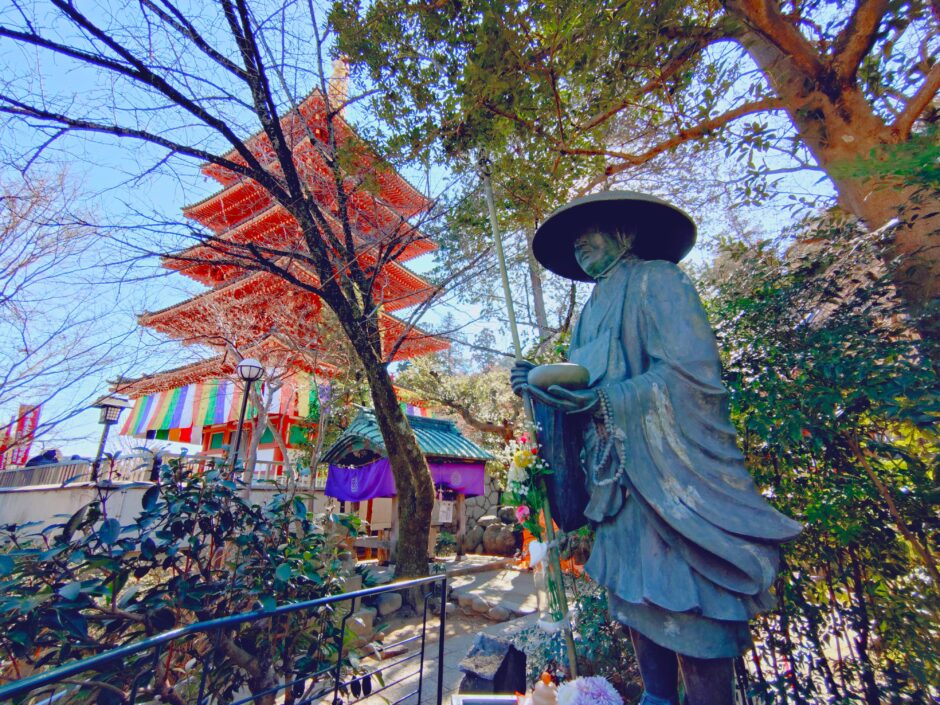

目次
- 【Takahata-Fudoson Kongoji Summary】
- 【Takahata-Fudoson Kongoji Nio-mon Gate】
- 【Takahata-Fudoson Kongoji Fudodo Hall】
- 【Takahata-Fudoson Kongoji main hall】
- 【Takahata-Fudoson Kongoji Five-storied pagoda】
- 【Takahata-Fudoson Kongoji Statue of Kūkai】
- 【Takahata-Fudoson Kongoji Dainichi-do Hall】
- 【Takahata-Fudoson Kongoji benten pond】
- 【Takahata-Fudoson Kongoji Relationship with Hijikata Toshizō】
- 【Takahata-Fudoson Kongoji Nearby attractions】
- 【This Stroll Route】
- 【Takahata-Fudoson Kongoji Access】
- Manager’s Comments
- Takahata-Fudoson Kongoji
【Takahata-Fudoson Kongoji Summary】
Takahata-Fudoson Kongoji Temple’s founding year is unclear, but it is said to have been established before the Taiho era (701-704) of the Nara period. Its origins trace back to the early Heian period when the monk Jikaku Daishi Ennin, acting on an imperial decree from Emperor Seiwa, built the Fudō Hall and established it as a sacred site for protecting the eastern region. It is also counted among the Three Great Fudō of Kantō and is a historic temple of the Shingon Chisan sect. Originally built deep in the mountains, the Fudō Hall collapsed in a great storm in 1335. In 1342, Priest Gikai relocated and rebuilt it at its present site.
The principal image is the Important Cultural Property “Fudō Myōō and Two Attendant Boys.”
【Takahata-Fudoson Kongoji Nio-mon Gate】
![20260201 111124947 1024x768 - Takahata-Fudoson Kongoji [Tokyo]](https://japan-shrine.info/wp-content/uploads/20260201_111124947-1024x768.jpg "Takahata-Fudoson Kongoji [Tokyo]")
The Nio-mon Gate, built between 1467 and 1572 (late Muromachi period), is designated as an Important Cultural Property of Japan. It underwent dismantling and restoration in 1959.
【Takahata-Fudoson Kongoji Fudodo Hall】
![20260201 111150846 1024x768 - Takahata-Fudoson Kongoji [Tokyo]](https://japan-shrine.info/wp-content/uploads/20260201_111150846-1024x768.jpg "Takahata-Fudoson Kongoji [Tokyo]")
Fudodo Hall, built in 1342 (early Muromachi period), is also designated as an Important Cultural Property of Japan.
【Takahata-Fudoson Kongoji main hall】
The inner sanctuary of Fudodo Hall houses the principal image: a seated statue of Fudō Myōō, along with statues of Kongara Dōji and Seitaka Dōji. These colossal statues, created in the early Heian period and weighing over 1,100 kg combined, are considered Japan’s largest.
![20260201 111541574 1024x768 - Takahata-Fudoson Kongoji [Tokyo]](https://japan-shrine.info/wp-content/uploads/20260201_111541574-1024x768.jpg "Takahata-Fudoson Kongoji [Tokyo]")
Photography is not permitted, but the statue of Fudō Myōō stands approximately 2.8 meters tall and is quite imposing when viewed up close.
【Takahata-Fudoson Kongoji Five-storied pagoda】
The Five-storied pagoda is beloved as a symbol of Takahata-Fudoson Kongoji.
![20260201 112823266 1024x768 - Takahata-Fudoson Kongoji [Tokyo]](https://japan-shrine.info/wp-content/uploads/20260201_112823266-1024x768.jpg "Takahata-Fudoson Kongoji [Tokyo]")
Standing 39.8 meters tall with a total height of 45 meters, its imposing presence captivates visitors.
【Takahata-Fudoson Kongoji Statue of Kūkai】
Statues of Kūkai can be found in various temples, but they are always present in Shingon temples.
![20260201 113517033 1024x768 - Takahata-Fudoson Kongoji [Tokyo]](https://japan-shrine.info/wp-content/uploads/20260201_113517033-1024x768.jpg "Takahata-Fudoson Kongoji [Tokyo]")
【Takahata-Fudoson Kongoji Dainichi-do Hall】
![20260201 113801792 1024x768 - Takahata-Fudoson Kongoji [Tokyo]](https://japan-shrine.info/wp-content/uploads/20260201_113801792-1024x768.jpg "Takahata-Fudoson Kongoji [Tokyo]")
The Dainichi-do Hall, located deep within the temple grounds, is apparently famous for its “singing dragon” painting on the ceiling that makes a sound when you clap your hands. However, I was unable to see it on that day.
【Takahata-Fudoson Kongoji benten pond】
![20260201 113057903 1024x768 - Takahata-Fudoson Kongoji [Tokyo]](https://japan-shrine.info/wp-content/uploads/20260201_113057903-1024x768.jpg "Takahata-Fudoson Kongoji [Tokyo]")
Right next to the Nio-mon Gate was Benten Pond. It seems to be a scenic spot where lotus flowers bloom in early summer, offering a beautiful view.
【Takahata-Fudoson Kongoji Relationship with Hijikata Toshizō】
![20260201 113145794 1024x768 - Takahata-Fudoson Kongoji [Tokyo]](https://japan-shrine.info/wp-content/uploads/20260201_113145794-1024x768.jpg "Takahata-Fudoson Kongoji [Tokyo]")
After the death of Hijikata Toshizō, who served as Vice-Commander of the Shinsengumi, this temple became his family temple for memorial services. Consequently, a bronze statue of Hijikata Toshizō stands within the temple grounds. It is believed the statue was placed near the mountain gate, a place he frequented as a boy and where he played during his youth.
【Takahata-Fudoson Kongoji Nearby attractions】
Keio Mogusaen, MogusaHachiman Shrine, Ono Shrine,
![20260201 103718640 520x300 - Takahata-Fudoson Kongoji [Tokyo]](https://japan-shrine.info/wp-content/uploads/20260201_103718640-520x300.jpg "Takahata-Fudoson Kongoji [Tokyo]")
![20260201 104355929 520x300 - Takahata-Fudoson Kongoji [Tokyo]](https://japan-shrine.info/wp-content/uploads/20260201_104355929-520x300.jpg "Takahata-Fudoson Kongoji [Tokyo]")
![20260201 093433972 520x300 - Takahata-Fudoson Kongoji [Tokyo]](https://japan-shrine.info/wp-content/uploads/20260201_093433972-520x300.jpg "Takahata-Fudoson Kongoji [Tokyo]")
【This Stroll Route】
![WalkingMap202602 en 1024x559 - Takahata-Fudoson Kongoji [Tokyo]](https://japan-shrine.info/wp-content/uploads/WalkingMap202602-en-1024x559.png "Takahata-Fudoson Kongoji [Tokyo]")
【Takahata-Fudoson Kongoji Access】
Manager’s Comments
As expected of a popular temple with its spacious grounds and many attractions, there were plenty of visitors. While you can see inside the inner sanctuary from the main worship hall, you can pay to enter inside. I think it’s definitely worth seeing if you come to this temple. I bought my daughter, who likes the anime Gintama, some Hijikata Toshizo sweets as a souvenir, but she didn’t seem interested… June is famous for its hydrangeas, so I’d like to visit again.
733 Takahata, Hino City, Tokyo 191-0031
※Free parking available.
Free parking is available, but it tends to fill up quickly and cause congestion. Rather than waiting for a long time, I think parking at a nearby paid lot and visiting the shrine will allow you to spend your time more meaningfully.
![a32bcccf0f041f061d8a1cebe96fd831 - Takahata-Fudoson Kongoji [Tokyo]](https://japan-shrine.info/wp-content/uploads/sng/a32bcccf0f041f061d8a1cebe96fd831.jpg "Takahata-Fudoson Kongoji [Tokyo]")