 Kanata's Japan Shrine Guide

目次
- 【Overview of Asakusa Otori Shrine】
- 【Asakusa Otori Shrine Approach (Sando)】
- 【Asakusa Otori Shrine Main Hall (Shaden)】
- 【Asakusa Otori Shrine: Nade Okame】
- 【Juzaisan Chokoku-ji Temple】
- 【Asakusa Otori Shrine Goshuin】
- 【Tourist Spots Near Asakusa Otori Shrine (Within a 30-minute walk)】
- 【Asakusa Otori Shrine Access】
- Admin’s Impressions
- Asakusa Otori Shrine Address
【Overview of Asakusa Otori Shrine】
The exact year Asakusa Otori Shrine was founded remains unknown. According to shrine legend, it originated when Yamato Takeru prayed for victory during his eastern expedition and hung a kumade (bamboo rake) on a pine branch in gratitude. There are various theories about its founding; another suggests it began in 1771 when Chokoku-ji Temple enshrined the deity Washimyoken Daibosatsu. Until the Edo period, it was a sub-shrine of the adjacent Chokoku-ji Temple known as “Otori Daimyojin,” but it became an independent shrine during the Meiji period due to the government policy separating Shinto and Buddhism.
In contrast to the Otori Shrine in Hanahata, Adachi City, which was called “Otori,” this shrine was apparently referred to as “Shintori.”
![20260131 135418761 160x160 - Asakusa Otori Shrine [Tokyo]](https://japan-shrine.info/wp-content/uploads/20260131_135418761-160x160.jpg "Asakusa Otori Shrine [Tokyo]") Hanahata Ōtori-jinja Shrine [Tokyo]
Hanahata Ōtori-jinja Shrine [Tokyo] The enshrined deities are Amenohiwashi-no-kami and Yamato Takeru-no-mikoto.
![30343286 m 1024x576 - Asakusa Otori Shrine [Tokyo]](https://japan-shrine.info/wp-content/uploads/30343286_m-1024x576.jpg "Asakusa Otori Shrine [Tokyo]")
【Asakusa Otori Shrine Approach (Sando)】
![20260212 112711418 1024x768 - Asakusa Otori Shrine [Tokyo]](https://japan-shrine.info/wp-content/uploads/20260212_112711418-1024x768.jpg "Asakusa Otori Shrine [Tokyo]")
During the Tori-no-Ichi festival, this approach is lined with numerous stalls, allowing you to enjoy a festive atmosphere. Normally, however, the lanterns and stalls are cleared away.
【Asakusa Otori Shrine Main Hall (Shaden)】
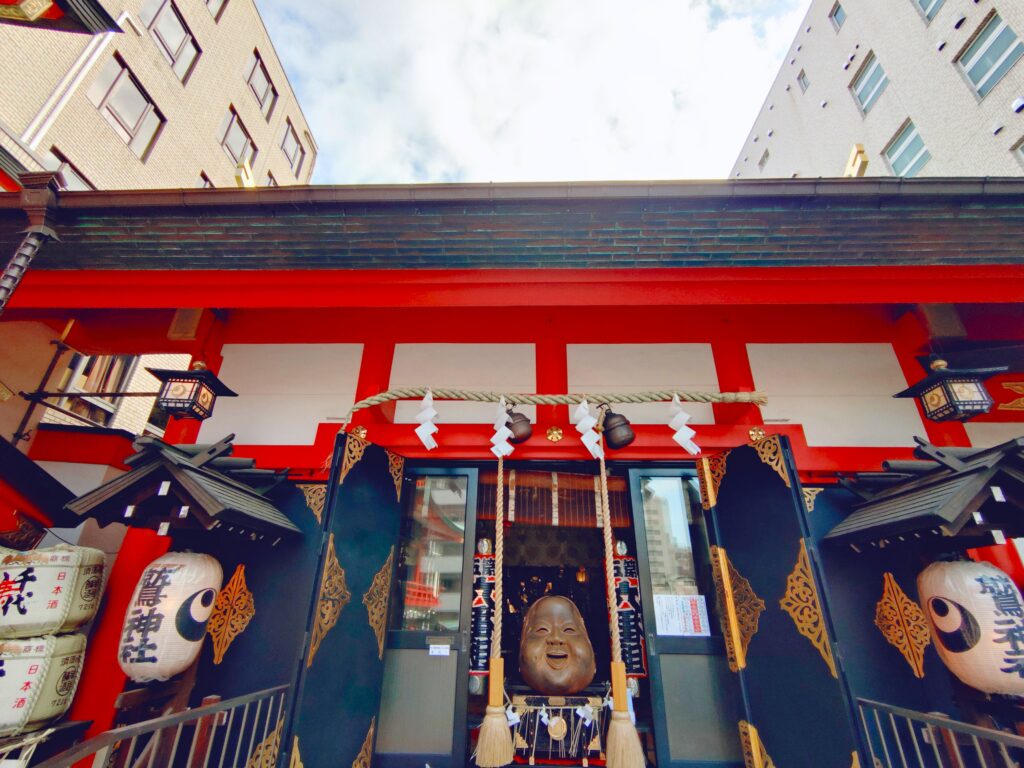
The large, vibrant vermilion-lacquered Main Hall easily catches the eye.
【Asakusa Otori Shrine: Nade Okame】
There is a large “Okame” (a traditional mask of a smiling woman) at the Worship Hall, and it is said that stroking different parts of her face grants different blessings.
![20260212 112307554 1024x768 - Asakusa Otori Shrine [Tokyo]](https://japan-shrine.info/wp-content/uploads/20260212_112307554-1024x768.jpg "Asakusa Otori Shrine [Tokyo]")
Stroking her forehead brings “wisdom,” her eyes “foresight,” her nose “financial luck,” her right cheek “success in love,” her left cheek “health,” and her mouth “protection from disaster.” If you stroke her clockwise from the chin, “things will be resolved smoothly.”
【Juzaisan Chokoku-ji Temple】
![20260212 113050938 1024x768 - Asakusa Otori Shrine [Tokyo]](https://japan-shrine.info/wp-content/uploads/20260212_113050938-1024x768.jpg "Asakusa Otori Shrine [Tokyo]")
Next to Otori Shrine is the temple where the “Asakusa Tori-no-Ichi” originated. It was founded around 1630. The principal object of worship at Chokoku-ji is the chant “Namu Myoho Renge Kyo.”
![20260212 113202737 1024x768 - Asakusa Otori Shrine [Tokyo]](https://japan-shrine.info/wp-content/uploads/20260212_113202737-1024x768.jpg "Asakusa Otori Shrine [Tokyo]")
After the temple and shrine were split, Otori Shrine became much larger and more famous, leaving this temple with a quiet, unassuming presence.
【Asakusa Otori Shrine Goshuin】
![otorisama GOSHUIN 711x1024 - Asakusa Otori Shrine [Tokyo]](https://japan-shrine.info/wp-content/uploads/otorisama-GOSHUIN-711x1024.jpg "Asakusa Otori Shrine [Tokyo]")
【Tourist Spots Near Asakusa Otori Shrine (Within a 30-minute walk)】
Ono Terusaki Shrine, Yoshiwara Shrine, Tobifudo, Senso-ji Temple.
![20260212 120426549 520x300 - Asakusa Otori Shrine [Tokyo]](https://japan-shrine.info/wp-content/uploads/20260212_120426549-520x300.jpg "Asakusa Otori Shrine [Tokyo]")
![20260212 114749779 520x300 - Asakusa Otori Shrine [Tokyo]](https://japan-shrine.info/wp-content/uploads/20260212_114749779-520x300.jpg "Asakusa Otori Shrine [Tokyo]")
![20260212 111822557 2 520x300 - Asakusa Otori Shrine [Tokyo]](https://japan-shrine.info/wp-content/uploads/20260212_111822557-2-520x300.jpg "Asakusa Otori Shrine [Tokyo]")
![27246462 m 520x300 - Asakusa Otori Shrine [Tokyo]](https://japan-shrine.info/wp-content/uploads/27246462_m-520x300.jpg "Asakusa Otori Shrine [Tokyo]")
【Asakusa Otori Shrine Access】
Admin’s Impressions
Having had the opportunity to visit Hanahata Otori Shrine, I wanted to visit this other Otori Shrine and made the trip. It is relatively large for an urban shrine, and since it is not too crowded outside of the Tori-no-Ichi festival and the New Year holidays, I enjoyed a very comfortable visit. The “Nade Okame” at the Worship Hall is quite unique and interesting. I don’t usually visit shrines at night and dislike crowded places, so I have never been to the Tori-no-Ichi, but I would like to experience it at least once.
3-18-7 Senzoku, Taito City, Tokyo 111-0031
Note: Free parking is available.