 Kanata's Japan Shrine Guide

【Overview & History of Rokugo Shrine】
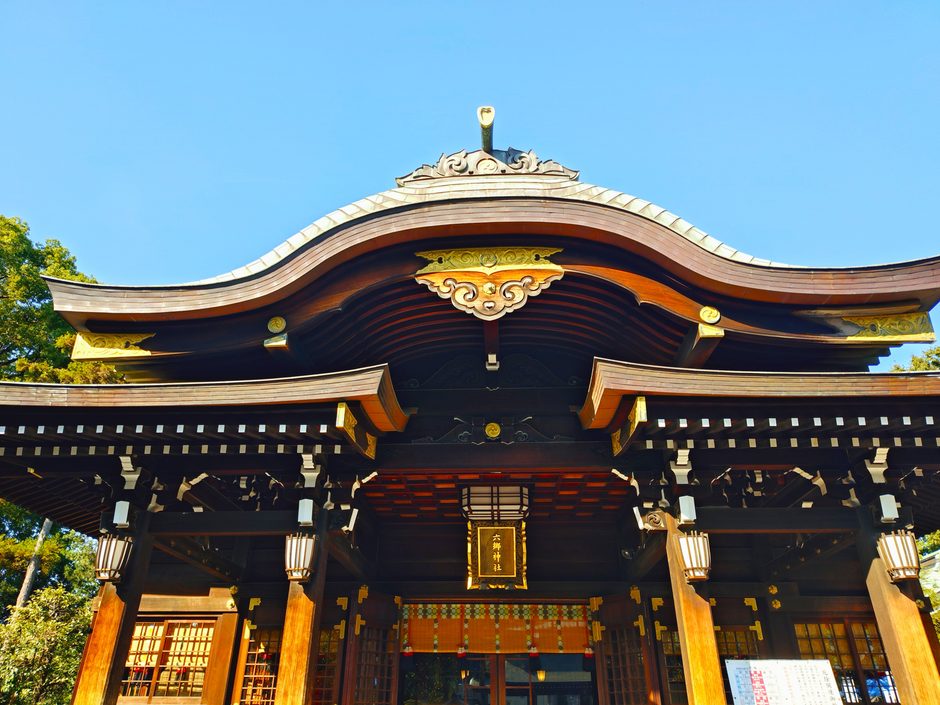
Located in Higashi-Rokugo, Ota Ward, Tokyo, Rokugo Shrine (Rokugo Jinja) is the overall guardian shrine of the 41 towns of the former Rokugo territory. As a Hachiman shrine—the clan deity (ujigami) of the Minamoto clan—its history from the Heian period through the Kamakura and Edo periods has been woven through deep ties with renowned military commanders who shaped Japanese history.
The place name “Rokugo” (“Six Villages”) prefixed to the shrine’s name actually originates from the fact that six representative villages (go) were gathered in this area from the Heian to Kamakura periods. During the Edo period, it became the name of a vast district encompassing 41 surrounding villages, and became affectionately known to many travelers as “Rokugo-no-Watashi” (Rokugo Ferry), a famous landmark on the Tokaido highway for crossing the Tama River by boat.
【History & Origins】An Ancient Shrine Proud of Its Minamoto Clan Heritage, Beginning with Lord Minamoto no Yoriyoshi’s Prayers
The origin of Rokugo Shrine dates back to 1057 (Tengai 5) in the late Heian period. At that time, Minamoto no Yoriyoshi, head of the Minamoto clan, and his son Minamoto no Yoshiie—known as “Hachiman Taro”—encamped here in Rokugo while heading east to quell a rebellion in the Tohoku region (the Former Nine Years’ War). On that occasion, they raised the “White Banner,” symbol of the Minamoto clan, high atop a large cedar tree on the grounds and fervently prayed toward Iwashimizu Hachimangu in Kyoto for martial luck and victory in battle. Having successfully suppressed the rebellion and achieved victory, father and son stopped by this site again on their return journey, enshrining a divided spirit from Iwashimizu Hachimangu and building a shrine hall as a token of gratitude. This became the origin of Rokugo Shrine.
In 1600 (Keicho 5), ahead of the Battle of Sekigahara, Tokugawa Ieyasu decided to construct the “Great Rokugo Bridge” (Rokugo Ohashi), an unprecedentedly massive wooden bridge across the Tama River, to move his armies. Ieyasu prayed at Rokugo Shrine for the safe completion of the bridge construction. The bridge was splendidly completed, and after winning the Battle of Sekigahara and unifying the nation, Ieyasu granted the shrine permission to use the Tokugawa family crest—the “Three-Leaf Hollyhock” (Mitsuba-aoi)—as its sacred emblem. Entering the Meiji period, the shrine was renamed from its former title “Hachimangu” to its current name “Rokugo Shrine” after the locality, and in 1872 (Meiji 5) it was ranked as a District Shrine (Gosha).
During the Edo period, travelers heading from Edo toward Kyoto crossed the Tama River via the “Rokugo Ferry” (Rokugo-no-Watashi) toward the Kawasaki-juku post town. Rokugo Shrine sits directly beside the old Tokaido road just before crossing the Tama River (on the Edo side). For travelers, it served as “the first and last vital guardian deity” where they prayed for safe travels or offered thanks for safely crossing the river.
This history of transit across the Tama River is deeply intertwined not only with travelers, but also with the faith of the people who developed the region. Long ago, parishioners (ujiko) of Rokugo Shrine crossed the river to settle and reclaim the land of Daishigawara in Musashi Province (present-day Kawasaki Ward, Kawasaki City, Kanagawa Prefecture) on the opposite bank. At that time, as the overall guardian deity of their new land, they enshrined “Emperor Nintoku”—the son (Wakamiya) of Rokugo Shrine’s enshrined deity, Emperor Ojin—establishing “Wakamiya Hachimangu Shrine” on the opposite shore.
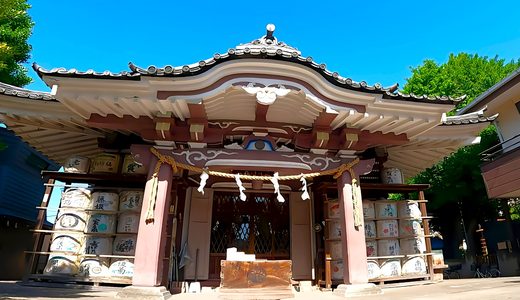
Emperor Nintoku, legendary for accomplishing flood control projects on the Yodo River, became the “guardian deity of flood control and land reclamation” for settlers who opened new rice fields with indomitable spirit while struggling against flooding from the Tama River.
In this way, “Rokugo Shrine” on the Edo side and “Wakamiya Hachimangu Shrine” on the Kawasaki side stand straddling the gateway of the great Tama River (Rokugo River), bound by an extraordinarily deep bond as parent-and-child deities that wove together the history of both the northern and southern banks.
【Enshrined Deity & Divine Blessings】Virtues of Winning Luck, Good Fortune, and Marital Harmony Granted by Hondawake-no-Mikoto
The enshrined deity is Hondawake-no-mikoto (Emperor Ojin).
Main Divine Blessings: Improved Winning Luck, Career Advancement & Good Fortune, Lasting Martial Luck, Business Success, and Academic Achievement.
【Highlights & Recommended Worship Route of Rokugo Shrine】
【Approach Path】A Lush Green Pathway Continuing Quietly from the Grand Torii into the Precincts
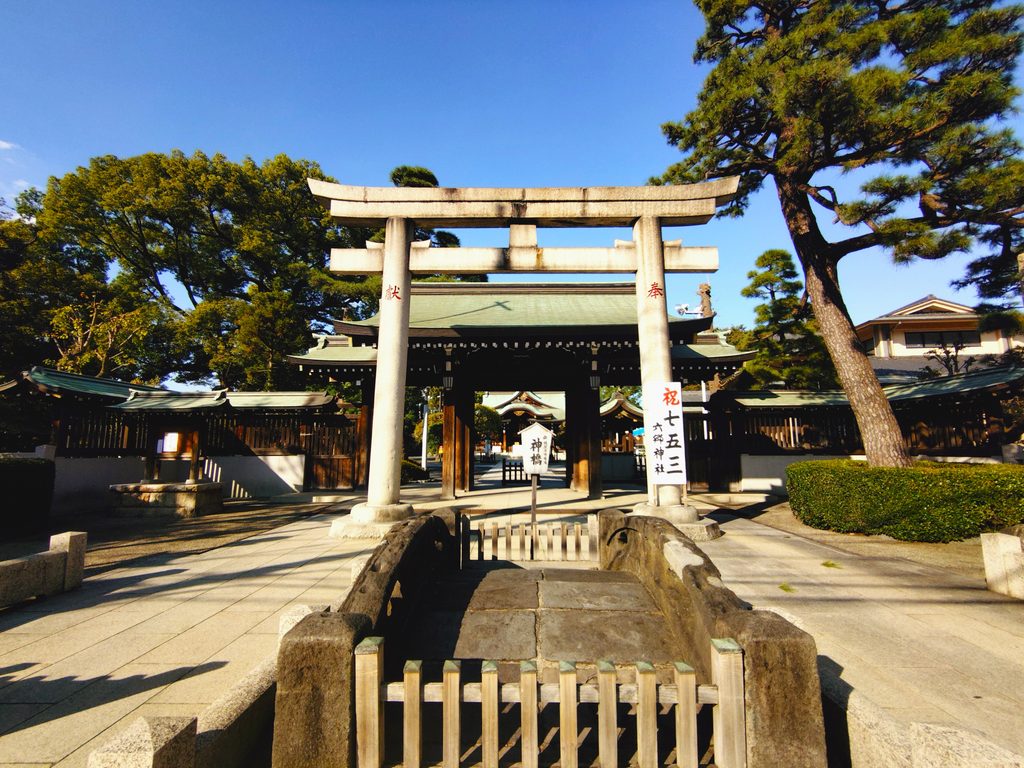
Despite being situated in a residential neighborhood, Rokugo Shrine boasts an exceptionally dignified and refreshing layout where the “Sacred Bridge, Torii Gate, Shinmon Gate, and Shrine Hall” align in straight, harmonious beauty. Standing at the entrance of the main approach (Omotesando), the first thing to catch your eye is the stately stone drum bridge (Taiko-bashi / Sacred Bridge). It is said to have been donated in 1191 (Kenkyu 2) by Kajiwara Kagetoki, a powerful vassal of the Kamakura Shogunate, when the shrine hall was constructed by order of Minamoto no Yoritomo.
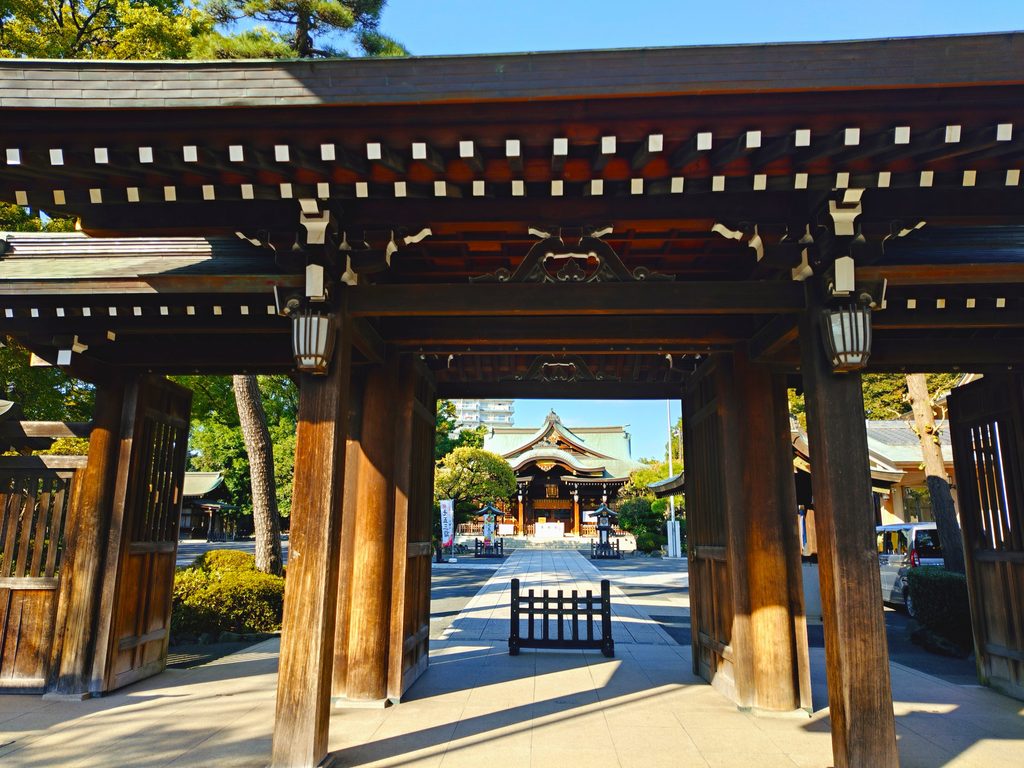
Passing beyond the Torii gate stands a massive wooden Shinmon Gate erected in 1987 (Showa 62). Unlike many modern structures built of reinforced concrete, this Shinmon Gate is built in an authentic wooden Romon (tower gate) style maximizing the warmth and strength of natural timber. Its beautiful tiled roof and imposing rows of thick wooden pillars exude high dignity, visually conveying to worshipers that an even deeper sacred space unfolds once you step through.
【Shrine Halls】A Dignified Worship Hall Evoking Legends of Lord Minamoto no Yoritomo’s Donations and Deep History
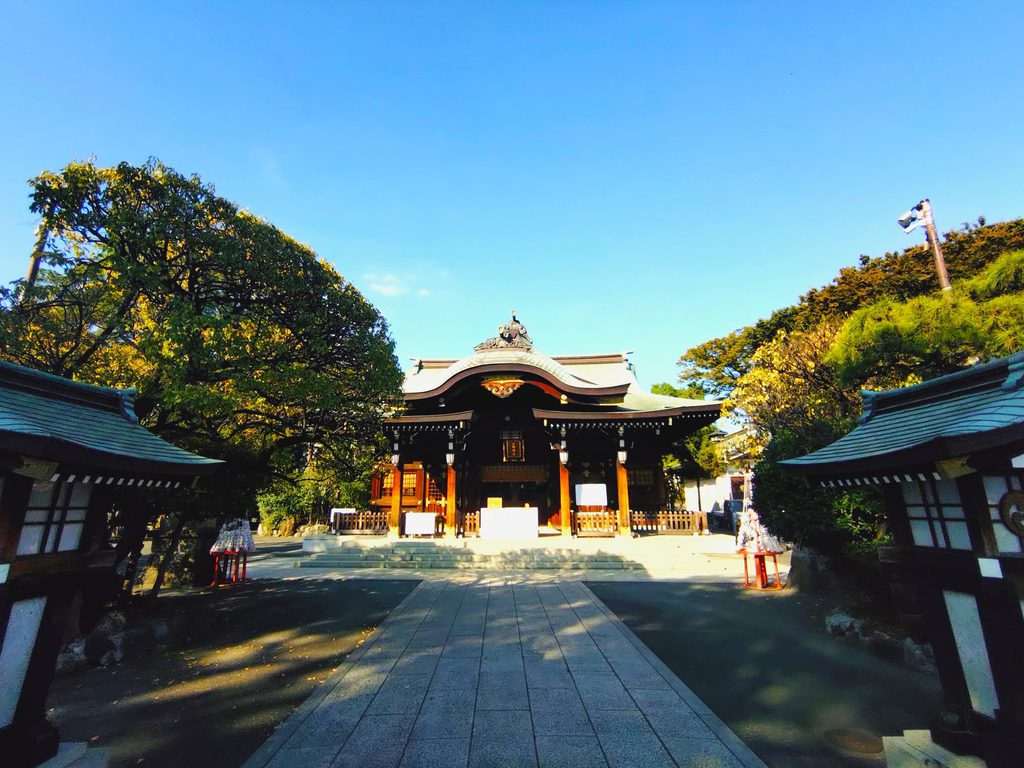
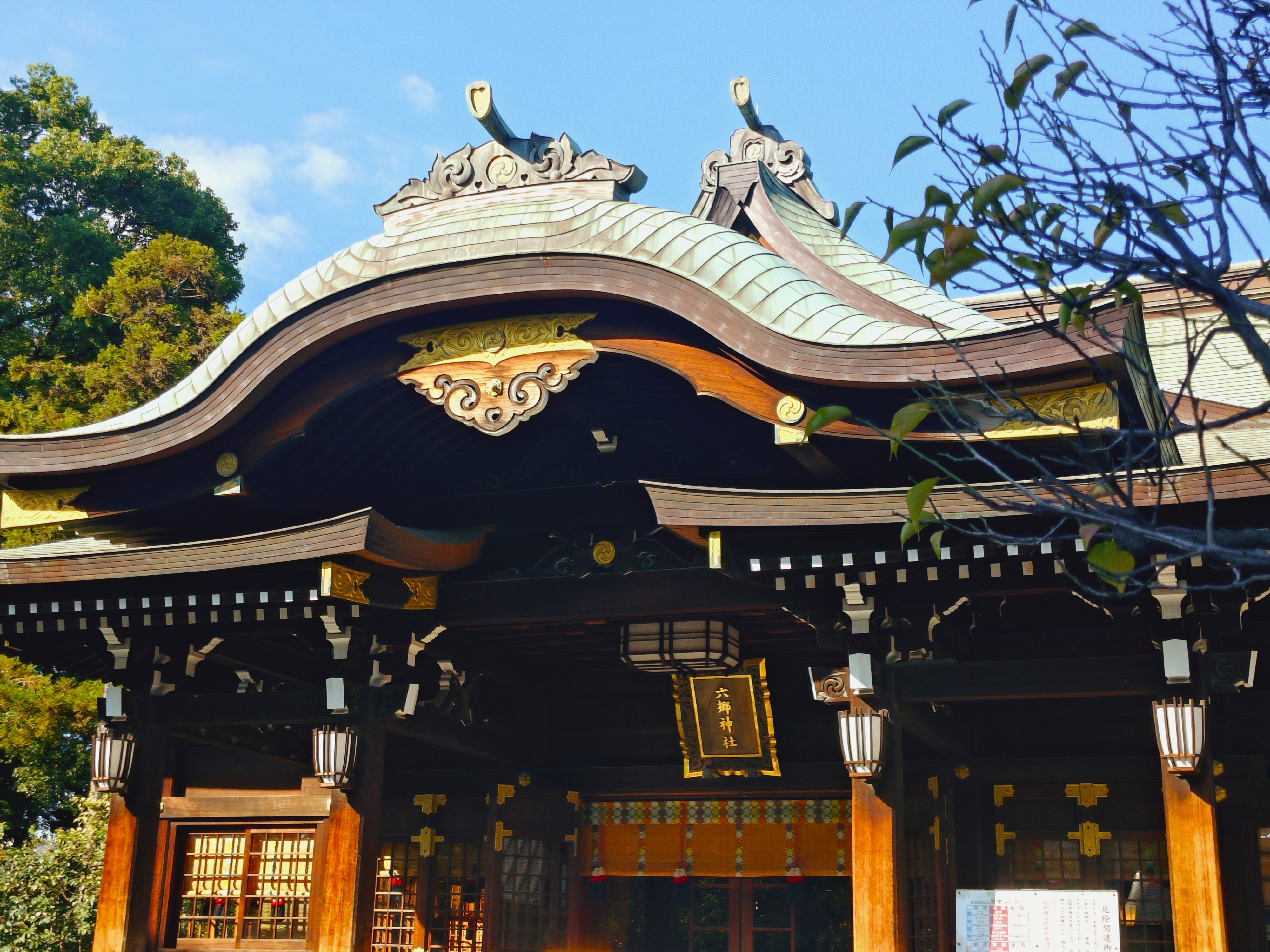
The shrine architecture adopts the substantial Gongen-zukuri style, uniting the Main Hall (Honden) and the front Worship Hall (Haiden) into a single complex. Furthermore, the Main Hall itself is a beautifully restored historical structure in the Sangen-sha Nagare-zukuri (three-bay flowing roof) style built in 1719 (Kyoho 4).
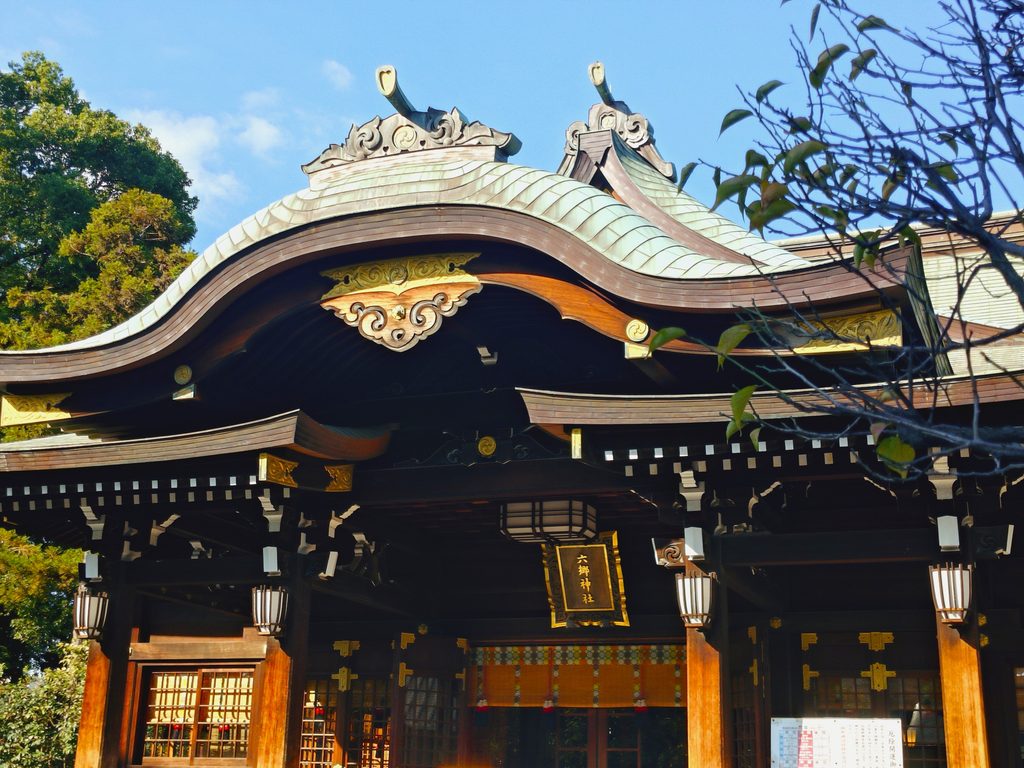
Looking closely at the intricate carvings—such as the kaerumata (frog-leg struts)—under the overhanging eaves (kohai) of the Worship Hall, you can spot the Tokugawa family’s “Three-Leaf Hollyhock” crest (Aoi-mon) finely carved alongside the traditional “Tomoe” swirl crest of Hachiman shrines.
【Meoto-gusu (Husband-and-Wife Camphor Trees)】Sacred Trees Standing Side-by-Side as a Symbol of Good Matchmaking and Marital Harmony
Meoto-gusu (Husband-and-Wife Camphor Trees) is the signature sacred tree representing Rokugo Shrine today.
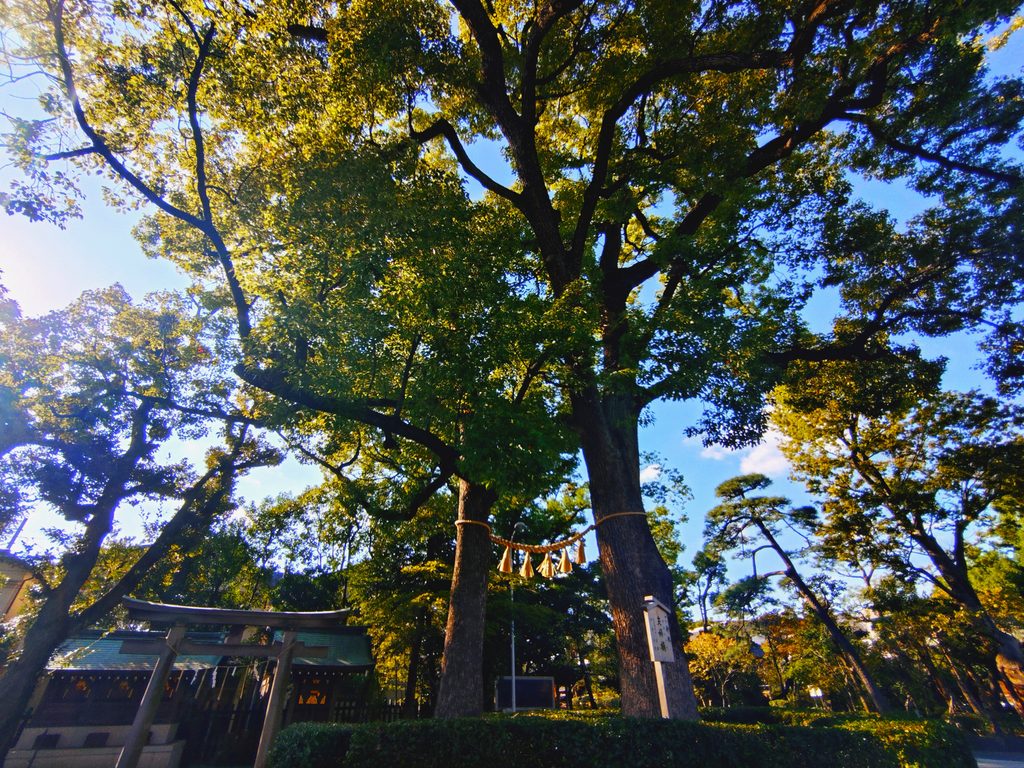
At its base near the ground, this camphor tree is firmly joined as a single thick trunk, but as it rises toward the sky, it splits neatly into two massive trunks that grow straight upward side-by-side. From this deeply affectionate appearance, it was named “Meoto-gusu.”
【Sub-shrines (Massha)】The Combined Shrine Hall and Inari Shrine Embodying Prayer and Faith
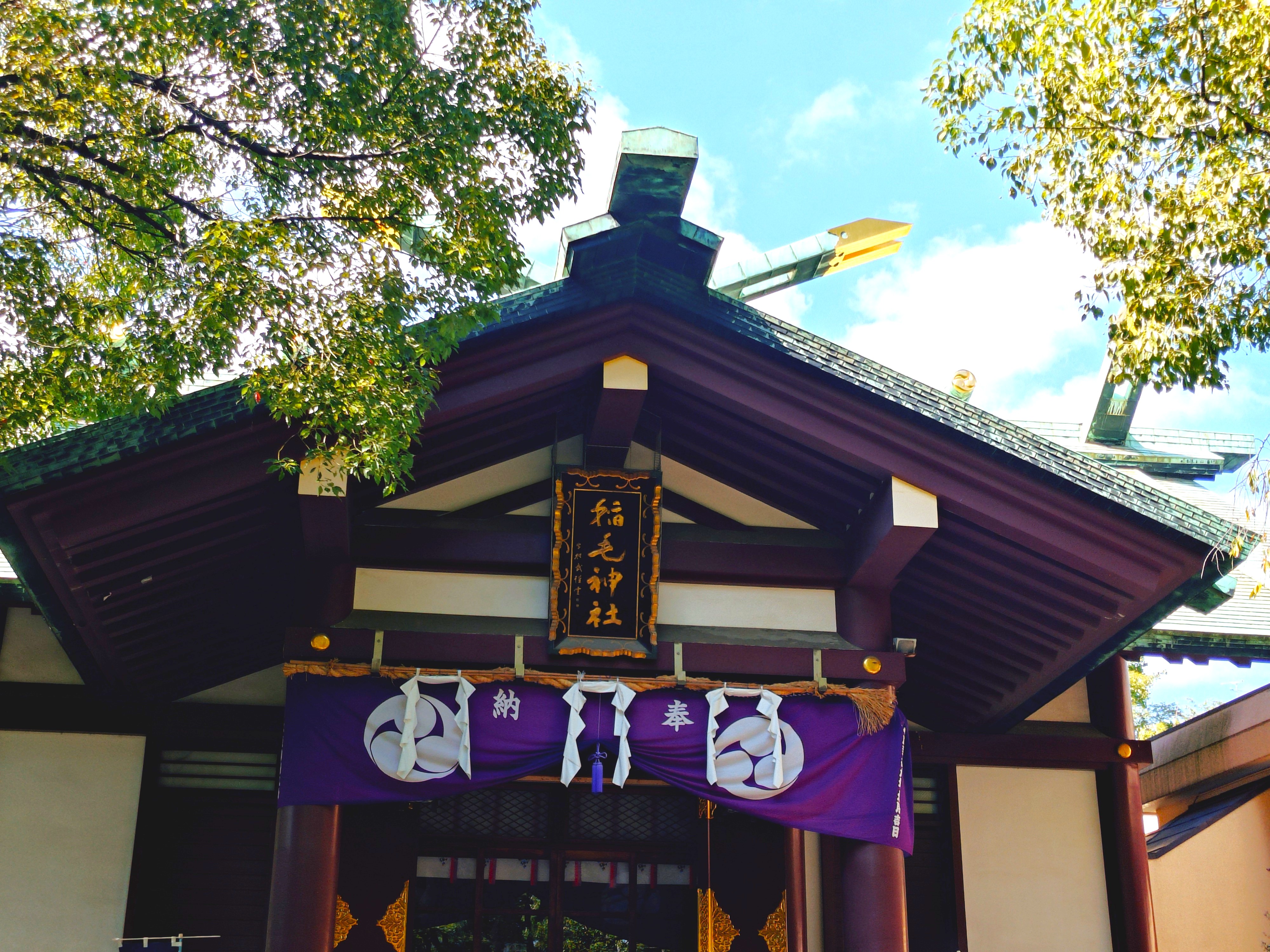
Within the grounds of Rokugo Shrine, there are four primary sub-shrines (massha). They are enshrined near the Meoto-gusu camphor trees just past the Torii gate.
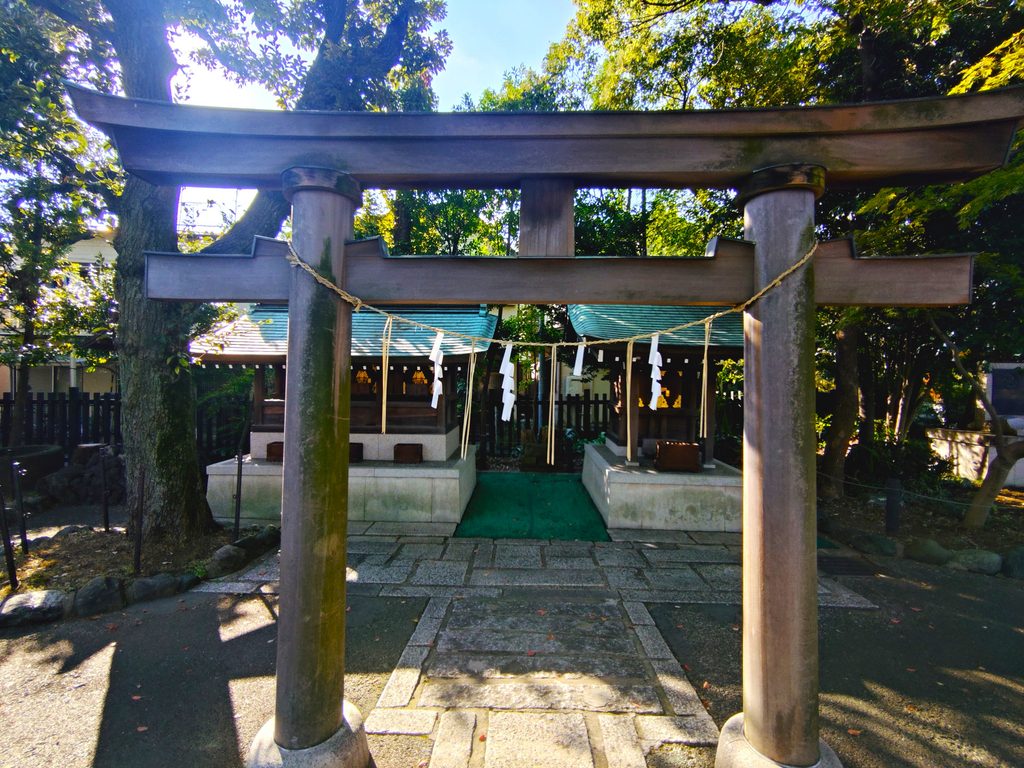
Goshi-den (Combined Shrine Hall): Located on the left side, this single hall enshrines the following three shrines side-by-side:
Hikawa Shrine (Hikawa Jinja): Susanoo-no-mikoto
Tenso Shrine (Tenso Jinja): Amaterasu Omikami
Mihashira Shrine (Mihashira Jinja): Yamatotakeru-no-mikoto, Omononushi-no-mikoto, and Futsunushi-no-mikoto
Inari Shrine (Inari Jinja): Standing independently on the right side, this shrine enshrines Ukanomitama-no-mikoto, the deity of abundant harvests and business prosperity.
【West Approach (Nishi-Sando)】Another Quiet Entrance Connecting with Local Daily Life
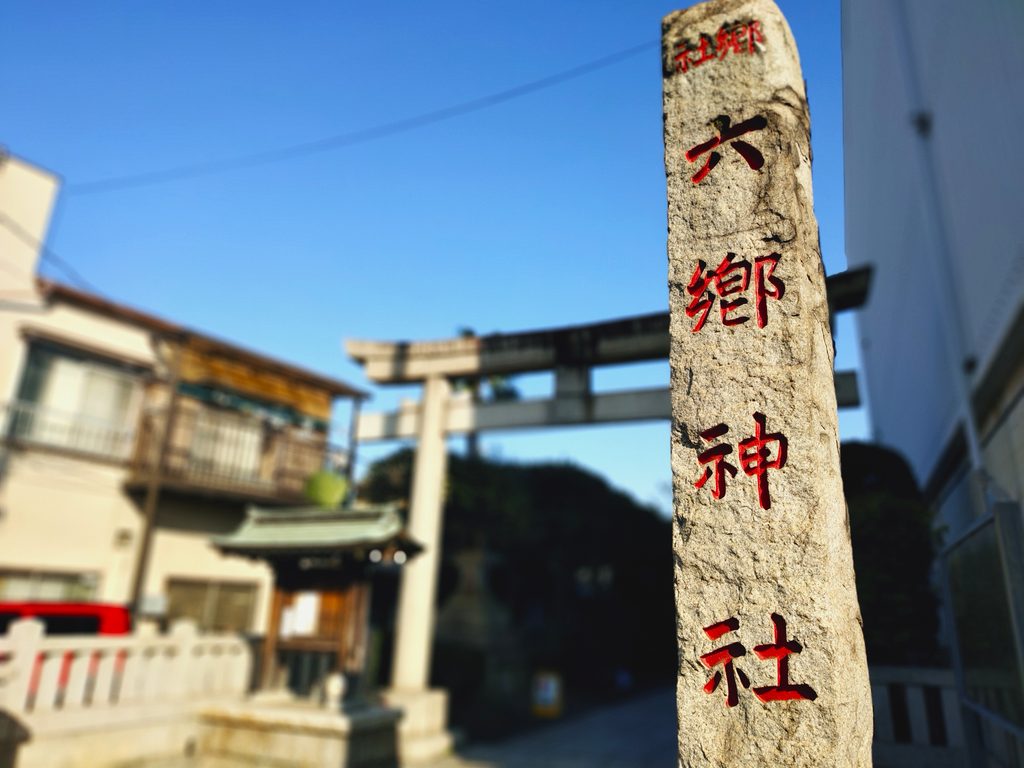
While Rokugo Shrine’s solemn, straight main approach from the old Tokaido is magnificent, the “West Approach” (Nishi-Sando) facing National Route 15 (Daiichi Keihin) also possesses an unmissable charm.
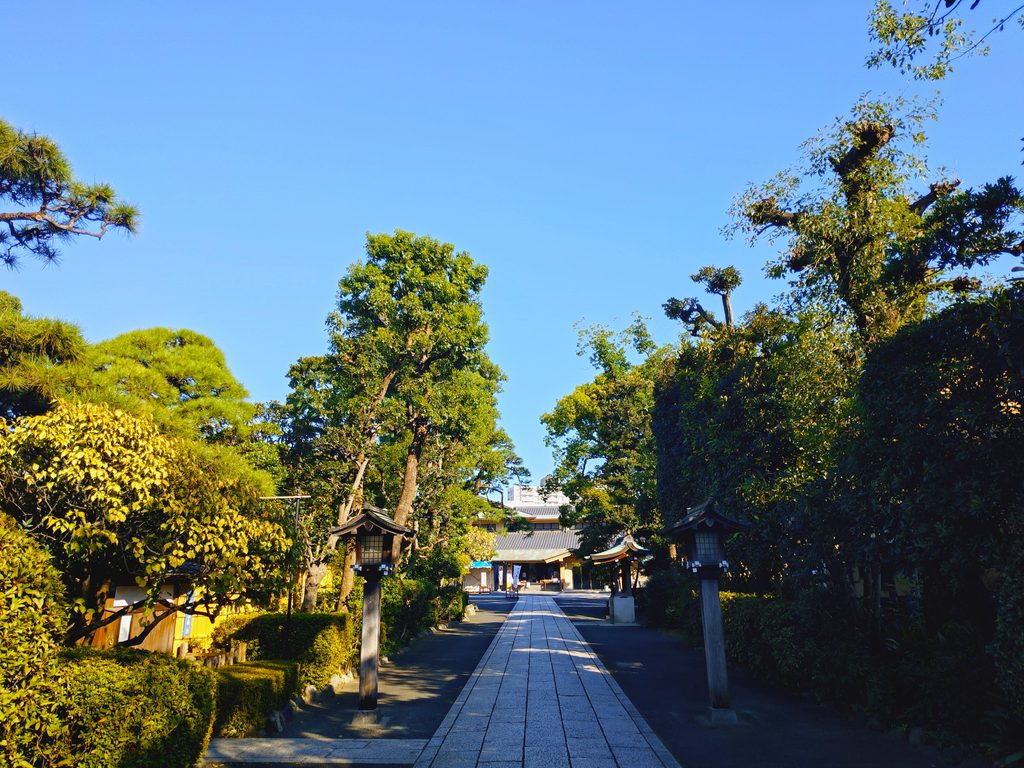
Passing through the large Torii gate from the main avenue reveals a spacious stone-paved path; as you walk forward, an open vista greets you with the grand shrine hall on your left and the Shinmon Gate on your right. While at first glance it appears to be a modernly landscaped entrance, it is actually a historic approach path depicted even in the Edo-period Edo Meisho Zue (Illustrated Guide to Famous Places of Edo), showing crowds of people passing through from this western side.
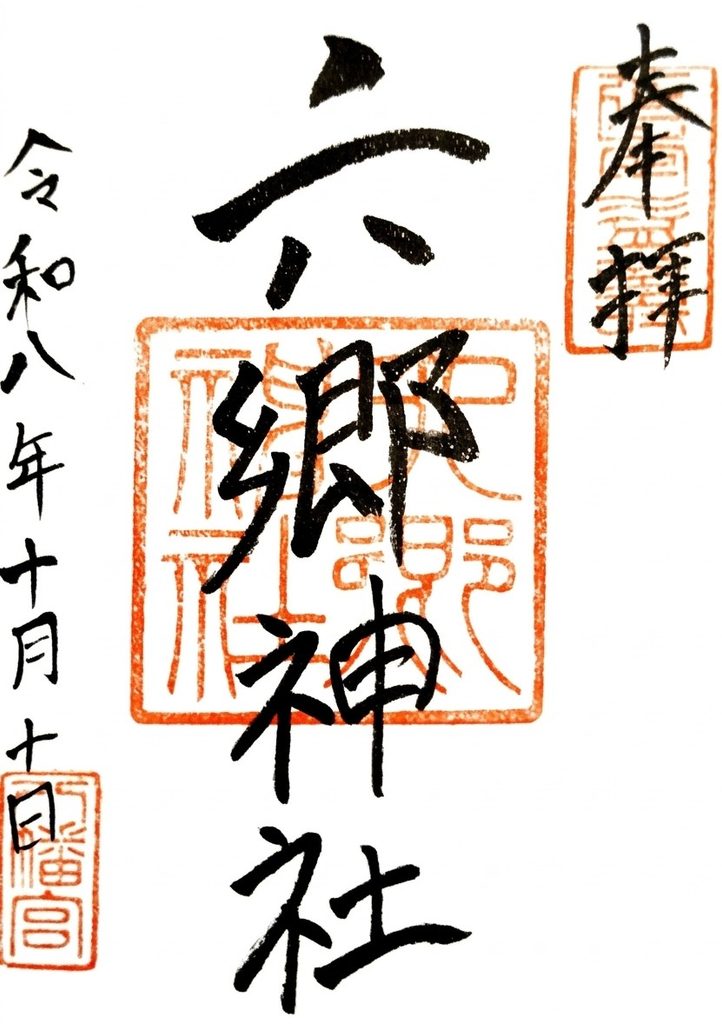
【Rokugo Shrine Goshuin】
【Rokugo Shrine On-Site Visit Report & Original Evaluation】
Rokugo Shrine On-Site Review & Evaluation Score
| Evaluation Category | Score | Key Features / Highlights |
|---|---|---|
| Accessibility | (4.0) | About a 7-minute walk from “Rokugodote Station” on the Keikyu Main Line, or accessible by bus from JR “Kamata Station.” Very smooth access from along Daiichi Keihin (National Route 15). |
| Tranquility | (4.0) | Despite being near a major thoroughfare, stepping onto the approach path surrounds you with lush greenery and the Shinmon Gate, filling the precinct with a tranquil and dignified sacred air. |
| History & Heritage | (4.0) | An ancient shrine originating in 1057 (Tengai 5) when Minamoto no Yoriyoshi and his son Yoshiie encamped and prayed for victory. Tokugawa Ieyasu also prayed here for the completion of the Great Rokugo Bridge prior to the Battle of Sekigahara. |
| Nature & Scenery | (3.5) | A beautiful and refreshing landscape harmonizing the stone drum bridge (Taiko-bashi) donated by Kajiwara Kagetoki, the stately wooden Shinmon Gate, and the greenery lining the approach path. |
| Scale & Grounds | (3.0) | An orderly precinct layout where the shrine hall retaining traces of the Kyoho era, the Shinto Sacred Bridge and Shinmon Gate, and sub-shrines are aligned in a straight, harmonious line. |
| Goshuin Variety | (3.0) | In addition to the regular Goshuin of “Rokugo Shrine,” prestigious seals featuring the Tokugawa family’s Three-Leaf Hollyhock crest and seasonal limited-edition Goshuin are issued. |
【On-Site Report | Personal Impressions and Atmosphere】
Stepping through the Torii gate instantly transforms the lively bustle of Daiichi Keihin (Old Tokaido) into a sacred, tranquil atmosphere. Entering the precincts, massive sacred trees hundreds of years old and a stately Torii gate—said to be the oldest in Ota Ward—welcome you as if wrapping you in warmth. You can tangibly feel the profound heritage and samurai spirit from when Minamoto no Yoriyoshi and his son Yoshiie prayed here for victory during their Oshu campaign. I think it is a wonderful shrine where the bustle of a modern city and the ancient serenity of a guardian deity harmonize comfortably. Visiting it together as a set with Wakamiya Hachimangu Shrine is highly recommended.
【Nearby Sightseeing Spots to Visit Together】
Wakamiya Hachimangu Shrine, Kamata Hachiman Shrine, Anamori Inari Shrine, Haneda Shrine, Kawasaki Daishi Heiken-ji Temple, Inage Shrine


【Basic Information & Access】
【Access by Train / Car and Parking】
*Free parking available.
【Address & Official Website】
3-10-18 Higashi-Rokugo, Ota Ward, Tokyo 144-0046