 Kanata's Japan Shrine Guide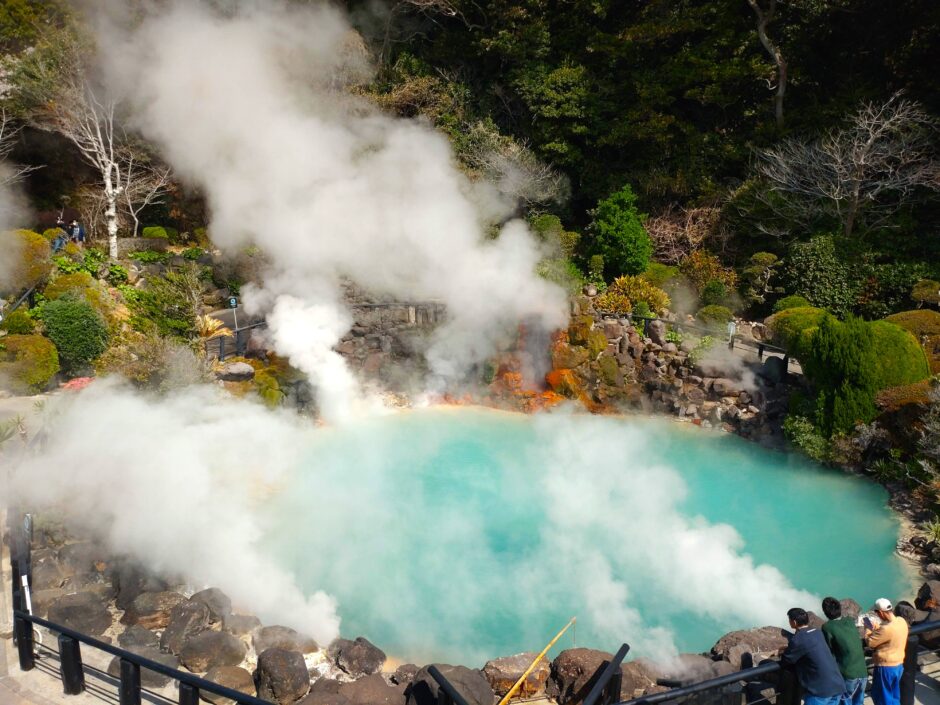

目次
- 【Overview of Beppu Jigoku Meguri】
- 【Beppu Jigoku Meguri: Umi Jigoku (Sea Hell)】
- 【Beppu Jigoku Meguri: Kamado Jigoku (Cooking Pot Hell)】
- 【Beppu Jigoku Meguri: Oniyama Jigoku (Monster Mountain Hell)】
- 【Beppu Jigoku Meguri: Chinoike Jigoku (Blood Pond Hell)】
- 【Nearby Tourist Spots】
- 【Beppu Jigoku Meguri Access】
- Admin’s Impressions
- Beppu Jigoku Meguri Address
- Beppu Jigoku Meguri Official Website
【Overview of Beppu Jigoku Meguri】
The Beppu Jigoku Meguri (Beppu Hell Tour) is a famous sightseeing spot featuring seven highly unique hot spring areas located in Beppu City, Oita Prefecture: Umi Jigoku (Sea Hell), Onishi Bozu Jigoku (Shaven Monk Head Hell), Kamado Jigoku (Cooking Pot Hell), Oniyama Jigoku (Monster Mountain Hell), Shiraike Jigoku (White Pond Hell), Chinoike Jigoku (Blood Pond Hell), and Tatsumaki Jigoku (Tornado Hell). It is characterized by hellish landscapes consisting of boiling water, hot mud, and vividly colored hot springs gushing up from deep underground, with several of these “hells” officially designated as National Places of Scenic Beauty. The name comes from the fact that people long ago used to refer to these unapproachable, hazardous areas as “hells.” Today, they have been beautifully developed as major tourist attractions where visitors can enjoy a variety of activities, including footbaths, gourmet food steamed with hot spring vapor, and even crocodile breeding.
![DSC 3174 2 1024x799 - Beppu Jigoku Meguri (Beppu Hell Tour) [Oita]](https://japan-shrine.info/wp-content/uploads/DSC_3174-2-1024x799.jpg "Beppu Jigoku Meguri (Beppu Hell Tour) [Oita]")
The price for a combo ticket covers admission to all seven hells: Adults (high school students and older): 2,400 yen; Elementary and junior high school students: 1,200 yen. They are open year-round, and it is standard practice to tour all seven locations.
【Beppu Jigoku Meguri: Umi Jigoku (Sea Hell)】
Umi Jigoku (Sea Hell) is the largest hell in Beppu, created by an eruption of Mount Tsurumi approximately 1,200 years ago. Designated as a National Place of Scenic Beauty, it features a mysterious, cobalt-blue hot spring (roughly 98°C) that looks exactly like the ocean due to the presence of iron sulfate in the water.
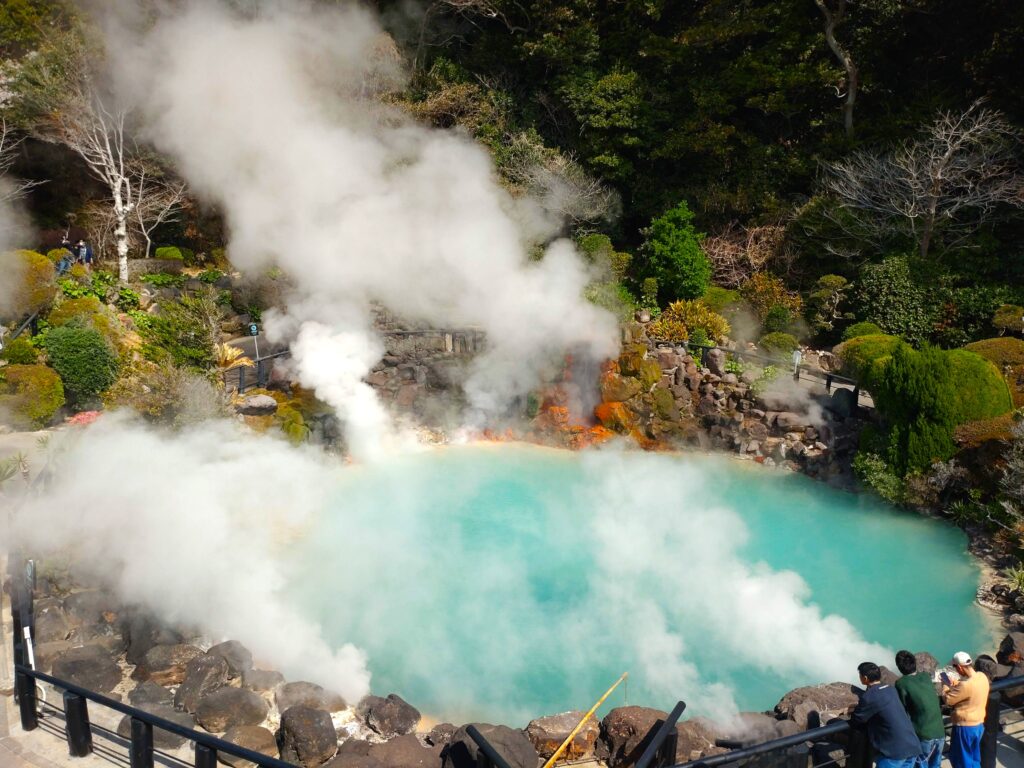
It stands as the largest-scale pool among the hells, offering a beautiful cobalt-blue sight.
【Hakuryu Inari Daimyojin Shrine Within the Umi Jigoku Precincts】
Enshrined within the grounds of Umi Jigoku, Hakuryu Inari Daimyojin is a beautiful hidden “power spot” where rising clouds of hot spring steam blend exquisitely with vibrant vermilion torii gates.
![DSC 3170 1024x768 - Beppu Jigoku Meguri (Beppu Hell Tour) [Oita]](https://japan-shrine.info/wp-content/uploads/DSC_3170-1024x768.jpg "Beppu Jigoku Meguri (Beppu Hell Tour) [Oita]")
The contrast between the torii gates and Umi Jigoku creates a genuinely striking landscape. Because there is no explanatory signboard on site, the exact origins of the shrine could not be officially confirmed, but historical contexts strongly suggest it was highly likely established during the Taisho period (the 1910s to the early 1920s). While the name of the enshrined deity is not officially stated either, it is presumed to be Ukanomitama no Kami.
![DSC 3171 1024x768 - Beppu Jigoku Meguri (Beppu Hell Tour) [Oita]](https://japan-shrine.info/wp-content/uploads/DSC_3171-1024x768.jpg "Beppu Jigoku Meguri (Beppu Hell Tour) [Oita]")
Since there is no shrine administrative office (shamusho) on the site, goshuin temple seals do not appear to be available.
【Beppu Jigoku Meguri: Kamado Jigoku (Cooking Pot Hell)】
Kamado Jigoku (Cooking Pot Hell) is a highly popular spot that feels just like a hell-themed amusement park, allowing visitors to experience many different varieties of hells (hot springs) all in a single location. Its name originates from an ancient tradition where the steam and volcanic vapors from this hell were used to cook the sacred rice offerings for the grand festival of the local guardian deity, Hachiman Kamado Shrine.
![DSC 3148 520x300 - Beppu Jigoku Meguri (Beppu Hell Tour) [Oita]](https://japan-shrine.info/wp-content/uploads/DSC_3148-520x300.jpg "Beppu Jigoku Meguri (Beppu Hell Tour) [Oita]")
According to legend, a demon who lost a wager to the gods thoroughly reflected upon his actions and mended his ways. In recognition of his hard work (specifically his capability to build 99 stone steps in a single night), the Hachiman deity officially acknowledged him and commanded: “From now on, change your heart and protect Kamado Jigoku well, where the sacred rice offerings for the shrine are cooked.” Ever since, it is said that the demon has stood at the entrance every single day as the gatekeeper of Kamado Jigoku, working diligently.
![DSC 3177 1024x768 - Beppu Jigoku Meguri (Beppu Hell Tour) [Oita]](https://japan-shrine.info/wp-content/uploads/DSC_3177-1024x768.jpg "Beppu Jigoku Meguri (Beppu Hell Tour) [Oita]")
The park features various hot spring ponds categorized from “1-chome” to “6-chome” (Zones 1 to 6), where visitors can witness color-changing ponds, experience footbaths, and even try drinking the hot spring water.
![DSC 3185 1024x768 - Beppu Jigoku Meguri (Beppu Hell Tour) [Oita]](https://japan-shrine.info/wp-content/uploads/DSC_3185-1024x768.jpg "Beppu Jigoku Meguri (Beppu Hell Tour) [Oita]")
At 5-chome, there is a mysterious hell where the color of the pond shifts depending on the day, varying between shades of green and blue.
【Beppu Jigoku Meguri: Oniyama Jigoku (Monster Mountain Hell)】
Oniyama Jigoku (Monster Mountain Hell) radiates an overwhelmingly distinct presence within the Beppu Hell Tour and is globally famous under its alternative name, “Crocodile Hell.” Operating since the Taisho period, it is Japan’s very first crocodile breeding facility, and currently, around 70 crocodiles are raised here utilizing the natural heat of the hot springs.
![DSC 3191 1024x768 - Beppu Jigoku Meguri (Beppu Hell Tour) [Oita]](https://japan-shrine.info/wp-content/uploads/DSC_3191-1024x768.jpg "Beppu Jigoku Meguri (Beppu Hell Tour) [Oita]")
Standing near the entrance is a large statue of a red demon, boasting a slightly retro yet fierce facial expression completely different from the one at Kamado Jigoku.
![DSC 3196 1024x768 - Beppu Jigoku Meguri (Beppu Hell Tour) [Oita]](https://japan-shrine.info/wp-content/uploads/DSC_3196-1024x768.jpg "Beppu Jigoku Meguri (Beppu Hell Tour) [Oita]")
As to why there are crocodiles in Beppu, the facility did not actually start for academic purposes or ecosystem conservation, but purely as a centerpiece for tourist entertainment back in 1923 (Taisho 12). Oniyama Jigoku gushes an astonishing volume of hot spring water—amounting to 30 kiloliters every single hour—at an ultra-high temperature of approximately 99.1°C. When exploring ways to harness this massive thermal energy, someone came up with a wild, unprecedented idea for the time that no one else would have imagined: using it to raise ferocious crocodiles from tropical regions that normally could not survive Japan’s winters.
![DSC 3194 1024x768 - Beppu Jigoku Meguri (Beppu Hell Tour) [Oita]](https://japan-shrine.info/wp-content/uploads/DSC_3194-1024x768.jpg "Beppu Jigoku Meguri (Beppu Hell Tour) [Oita]")
A crocodile named “Ichiro,” who was once raised here, grew into one of the largest crocodiles in the world—reaching 5 meters in length, 600 kilograms in weight, and living to the advanced age of 71. Today, a full-scale taxidermy mount of Ichiro is on display at the museum inside the park. A major highlight for visitors is the “Crocodile Feeding Show” held every Saturday and Sunday.
【Beppu Jigoku Meguri: Chinoike Jigoku (Blood Pond Hell)】
Because Chinoike Jigoku (Blood Pond Hell) is located slightly far away from Umi Jigoku, traveling by car is highly recommended.
![DSC 3201 1024x768 - Beppu Jigoku Meguri (Beppu Hell Tour) [Oita]](https://japan-shrine.info/wp-content/uploads/DSC_3201-1024x768.jpg "Beppu Jigoku Meguri (Beppu Hell Tour) [Oita]")
It is an incredibly popular spot within the Beppu hot spring hell tour, perfectly matching the iconic image one envisions when picturing a hellish landscape. Standing as Japan’s oldest natural hell, it is characterized by its vivid red hot mud containing iron oxide.
![DSC 3203 1024x768 - Beppu Jigoku Meguri (Beppu Hell Tour) [Oita]](https://japan-shrine.info/wp-content/uploads/DSC_3203-1024x768.jpg "Beppu Jigoku Meguri (Beppu Hell Tour) [Oita]")
The park grounds are spacious and feature a designated spot where large groups can take commemorative photos. There is also a large gift shop well-stocked with a wide variety of souvenirs, including local sake. In keeping with the theme of Blood Pond Hell, they even sell ultra-spicy snacks.
【Nearby Tourist Spots】
Hachiman Kamado Shrine, Usa Jingu Shrine
![DSC 3247 520x300 - Beppu Jigoku Meguri (Beppu Hell Tour) [Oita]](https://japan-shrine.info/wp-content/uploads/DSC_3247-520x300.jpg "Beppu Jigoku Meguri (Beppu Hell Tour) [Oita]")
【Beppu Jigoku Meguri Access】
Admin’s Impressions
With hot spring steam rising directly out of the city streets, the entire town embraces an atmosphere of hot spring enjoyment. The surrounding facilities and the overall area are exceptionally well-developed as a tourist destination, making it a place where even first-time visitors can explore with peace of mind.
As a point of caution, the hells are largely concentrated into two separate main areas, making a means of transportation like a car necessary. Since Chinoike Jigoku and Tatsumaki Jigoku are located about 4 kilometers away from the others, it is wise to plan your route in advance. In my case, I first parked my car at the Umi Jigoku parking lot and purchased the combo ticket, toured Umi Jigoku → Onishi Bozu Jigoku, and then moved my car to the Kamado Jigoku parking lot. From there, I walked to tour Kamado Jigoku → Oniyama Jigoku → Shiraike Jigoku. After that, I drove over to Chinoike Jigoku.
559-1 Kannawa, Beppu, Oita 874-0000
*Free parking available.
![882c29df15eda015c6d4befc618dfa25 - Beppu Jigoku Meguri (Beppu Hell Tour) [Oita]](https://japan-shrine.info/wp-content/uploads/sng/882c29df15eda015c6d4befc618dfa25.jpg "Beppu Jigoku Meguri (Beppu Hell Tour) [Oita]")