 Kanata's Japan Shrine Guide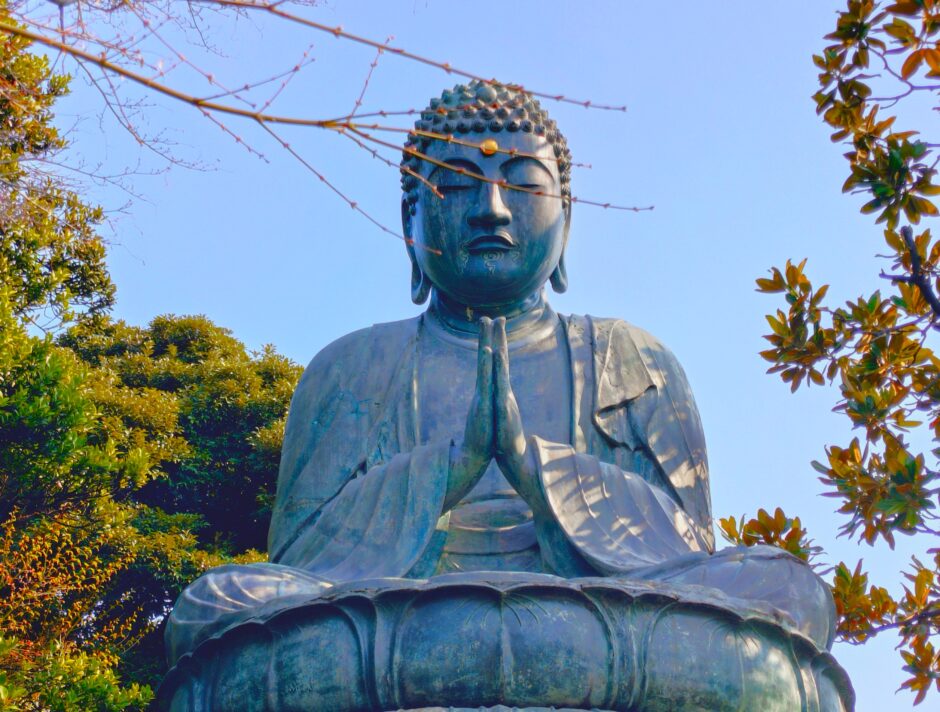

目次
- 【Overview of Tennoji Temple】
- 【Tennoji Yanaka Daibutsu (Seated Shaka Nyorai Statue)】
- 【Tennoji Main Hall (Hondo)】
- 【Tennoji Bishamon-do Hall】
- 【Tennoji: The Birthplace of Tomikuji Lotteries】
- 【Yanaka Cemetery Sakura-dori Avenue】
- 【Nearby Tourist Spots (Within a 30-Minute Walk)】
- 【Tennoji Access】
- Admin’s Impressions
- Tennoji Address
- Tennoji Official Website
【Overview of Tennoji Temple】
The founding of Tennoji Temple is said to date back to 1274 (Bun’ei 11) during the Kamakura period.
Its history began when the Buddhist monk Nichiren Shonin, while traveling from Awa Province (present-day Chiba Prefecture) to Kamakura, stayed at the residence of Seki Kojiro Tateaki, a local lord of this area. Deeply moved by Nichiren’s teachings, Tateaki converted to the faith and built a simple grass hut. Later, Nichiren’s disciple Nichigen invited and enshrined the Hokke Mandala (the Lotus Mandala) to formally open the temple. At the time, it was a Nichiren-sect temple known as “Kanno-ji,” but it belonged to a sub-sect called the Fujufuse (non-reception and non-giving) faction, which held unyielding, fierce convictions. The Tokugawa Shogunate banned this faction and presented the temple with a harsh ultimatum: “Convert to the Tendai sect, or face forced closure.” Consequently, the temple transitioned to the Tendai sect.
Today, it is a temple of the Tendai sect, and its formal name is Gokokuzan Sonjuin Tennoji.
【Tennoji Yanaka Daibutsu (Seated Shaka Nyorai Statue)】
![20260329 085955304 1024x768 - Tennoji Temple [Tokyo]](https://japan-shrine.info/wp-content/uploads/20260329_085955304-1024x768.jpg "Tennoji Temple [Tokyo]")
Enshrined on the right side as you enter the main temple gate (Sanmon) is a large bronze Great Buddha (Daibutsu) standing approximately 4.8 meters tall.
![20260329 085418939 2 1024x768 - Tennoji Temple [Tokyo]](https://japan-shrine.info/wp-content/uploads/20260329_085418939-2-1024x768.jpg "Tennoji Temple [Tokyo]")
Cast in 1690 (Genroku 3) by the master founder Ota Kyuemon, this statue demonstrates the exceptionally high level of casting technology achieved during the Edo period. It is currently designated as a Tangible Cultural Property of Taito Ward.
![DSC 3195 160x160 - Tennoji Temple [Tokyo]](https://japan-shrine.info/wp-content/uploads/DSC_3195-160x160.jpg "Tennoji Temple [Tokyo]") Tokyo Daibutsu (Jorenji Temple) and Akatsuka Botanical Garden [Tokyo]
Tokyo Daibutsu (Jorenji Temple) and Akatsuka Botanical Garden [Tokyo] Additionally, another Great Buddha statue, affectionately known as the “Tokyo Daibutsu,” is enshrined at Jorenji Temple in Tokyo. While its appearance resembles Great Buddha statues found elsewhere, its unique characteristic is that its principal image is Amida Nyorai.
【Tennoji Main Hall (Hondo)】
![20260329 085941837 2 1024x768 - Tennoji Temple [Tokyo]](https://japan-shrine.info/wp-content/uploads/20260329_085941837-2-1024x768.jpg "Tennoji Temple [Tokyo]")
The current main hall was rebuilt modeled after the national treasure “Jurin-in” in Nara. It features a traditional Yosemune-zukuri (hipped roof) design with a clean, streamlined layout that lacks a Nagare-gohai (an extended roof projection over the entrance steps). The quiet appearance framed by rows of standing pillars leaves a deeply serene impression.
![20260329 085908308 1024x768 - Tennoji Temple [Tokyo]](https://japan-shrine.info/wp-content/uploads/20260329_085908308-1024x768.jpg "Tennoji Temple [Tokyo]")
A weeping cherry tree (Shidare-zakura) is planted right next to the main hall, making the scenery absolutely beautiful during the cherry blossom season.
【Tennoji Bishamon-do Hall】
![20260329 085714908 1024x768 - Tennoji Temple [Tokyo]](https://japan-shrine.info/wp-content/uploads/20260329_085714908-1024x768.jpg "Tennoji Temple [Tokyo]")
Bishamonten is enshrined here as one of the deities of the “Yanaka Seven Lucky Gods,” which is considered the oldest Seven Lucky Gods pilgrimage circuit in Tokyo (Edo). The statue of Bishamonten housed inside the main hall is designated as a Tangible Cultural Property of Taito Ward.
![20260329 085809105 1024x768 - Tennoji Temple [Tokyo]](https://japan-shrine.info/wp-content/uploads/20260329_085809105-1024x768.jpg "Tennoji Temple [Tokyo]")
Cherry blossoms also bloom beautifully in front of the Bishamon-do Hall, making it highly picturesque.
【Tennoji: The Birthplace of Tomikuji Lotteries】
![edo lottery1 1024x677 - Tennoji Temple [Tokyo]](https://japan-shrine.info/wp-content/uploads/edo-lottery1-1024x677.jpg "Tennoji Temple [Tokyo]")
During the Edo period, this temple was also famous as a venue for hosting Tomikuji (an early form of today’s public lottery), alongside Meguro Fudo and Yushima Tenjin, which together were celebrated as the “Three Lotteries of Edo.” There is a touch of historical irony here: it was precisely because of the Shogunate’s forced religious conversion that the temple came under the heavy financial protection of the Tokugawa government, allowing it to develop into a highly influential institution capable of hosting the massive “Three Lotteries of Edo.” *The image is from the collection of the National Diet Library.
【Yanaka Cemetery Sakura-dori Avenue】
![20260329 090222658 1024x768 - Tennoji Temple [Tokyo]](https://japan-shrine.info/wp-content/uploads/20260329_090222658-1024x768.jpg "Tennoji Temple [Tokyo]")
Within the Yanaka Cemetery, there is a “Sakura-dori” (Cherry Blossom Avenue) where roughly 160 Somei-Yoshino cherry trees stretch beautifully along a 200-meter path. Unlike Ueno Park, this spot is not overly crowded, making it a hidden gem in a sense… However, my impression was that there were almost no Japanese people strolling here; instead, it was heavily visited by international tourists.
【Nearby Tourist Spots (Within a 30-Minute Walk)】
Kaneiji Temple, Tokyo National Museum, Ueno Toshogu Shrine, Shinobazu Pond Bentendo, Nezu Shrine
![20260329 100126210 520x300 - Tennoji Temple [Tokyo]](https://japan-shrine.info/wp-content/uploads/20260329_100126210-520x300.jpg "Tennoji Temple [Tokyo]")
![DSC 1755 3 520x300 - Tennoji Temple [Tokyo]](https://japan-shrine.info/wp-content/uploads/DSC_1755-3-520x300.jpg "Tennoji Temple [Tokyo]")
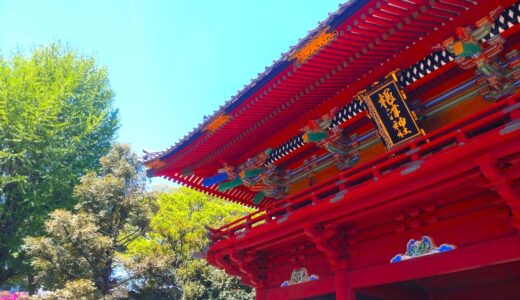
【Tennoji Access】
Admin’s Impressions
Today, Tennoji Temple exists in a way that blends completely into the vast grounds of Yanaka Cemetery. The historical weight of having its past power and political influence stripped away by the government leaves a lingering sensation of an isolated, detached space—even though the grounds are immaculately maintained. While the cherry blossoms at Yanaka Cemetery were certainly beautiful, Japanese people generally do not hold the mindset of “intentionally going to a cemetery for cherry blossom viewing,” which explains why the visitors were almost exclusively international tourists. Personally, I don’t think I will visit a cemetery for cherry blossom viewing again.
![de1520926c36b61b493416b06ccf3769 - Tennoji Temple [Tokyo]](https://japan-shrine.info/wp-content/uploads/sng/de1520926c36b61b493416b06ccf3769.gif "Tennoji Temple [Tokyo]")