 Kanata's Japan Shrine Guide

目次
- 【Overview of Zoshigaya Kishimojin-do】
- 【The Shrine Approach (Sando)】
- 【The Main Hall (Hondo)】
- 【The Temple Crest (Temon)】
- 【The Giant Ginkgo Tree Within the Precincts】
- 【The Guardian Deity of the Land: Takeyoshi Inari Daimyojin】
- 【Precincts Shrine: Hokushin Myoken Dai-Bosatsu】
- 【Precincts Shrine: Nori Fudo-do】
- 【The Strength Stones and the Tea Kettle】
- 【The Old-Fashioned Sweet Shop: Kamikawaguchi-ya】
- 【Goshuin】
- 【Nearby Tourist Spots (Within a 30-Minute Walk)】
- 【Recommended Walking Route Including Zoshigaya Kishimojin-do】
- 【Zoshigaya Kishimojin-do Temple Access】
- Admin’s Impressions
- Address of Zoshigaya Kishimojin-do Temple
- Zoshigaya Kishimojin-do Temple Official Website
【Overview of Zoshigaya Kishimojin-do】
The founding of Zoshigaya Kishimojin-do Temple is said to date back to 1578 (Tensho 6) during the Azuchi-Momoyama period. Its history began in 1561 (Eiroku 4) when a statue of Kishimojin was dug up from a farm plot in Mejirodai, Bunkyo Ward, and was initially housed at Toyo-bo (the precursor to the present-day Homyoji Temple). In 1578, the villagers of Zoshigaya erected a worship hall at the current location to formally enshrine the sacred statue.
The principal image (Honzon) of the temple is the Kishimojin Sonzo (Statue of Kishimojin), from which the hall takes its name.
![DSC 0517 1024x768 - Zoshigaya Kishimojin-do Temple [Tokyo]](https://japan-shrine.info/wp-content/uploads/DSC_0517-1024x768.jpg "Zoshigaya Kishimojin-do Temple [Tokyo]")
【The Shrine Approach (Sando)】
The entrance to the precincts lacks a formal gate building; instead, two stone Nio statues stand in the open air to greet incoming worshippers.
![20260616 132956236 1024x768 - Zoshigaya Kishimojin-do Temple [Tokyo]](https://japan-shrine.info/wp-content/uploads/20260616_132956236-1024x768.jpg "Zoshigaya Kishimojin-do Temple [Tokyo]")
These two powerful Kongorikishi (Wrathful Guardian) Statues are said to have been crafted in the early 1700s. Researching the site reveals that even during the Edo period, there was never a fully roofed, grand “gate building” (such as a Sanmon or Niomon) standing at the entrance of the grounds. Instead, because Otori Shrine used to be located right here, a Shinto torii gate once stood on this spot, which was likely dismantled during the government-mandated separation of Shinto and Buddhism.
![20260616 131645132 160x160 - Zoshigaya Kishimojin-do Temple [Tokyo]](https://japan-shrine.info/wp-content/uploads/20260616_131645132-160x160.jpg "Zoshigaya Kishimojin-do Temple [Tokyo]") Zoshigaya Otori Shrine [Tokyo]
Zoshigaya Otori Shrine [Tokyo] 【The Main Hall (Hondo)】
![20260616 133145860 2 1024x768 - Zoshigaya Kishimojin-do Temple [Tokyo]](https://japan-shrine.info/wp-content/uploads/20260616_133145860-2-1024x768.jpg "Zoshigaya Kishimojin-do Temple [Tokyo]")
The worship hall (Haiden) was erected in 1664, and the main sanctuary (Honden) was constructed in 1700 through a generous donation from the Hiroshima Domain. Designated as a National Important Cultural Property in 2016, this temple feels profoundly historical, showcasing architectural masterworks alongside a massive 700-year-old sacred ginkgo tree and the Takeyoshi Inari Shrine.
![20260616 133244399 1024x768 - Zoshigaya Kishimojin-do Temple [Tokyo]](https://japan-shrine.info/wp-content/uploads/20260616_133244399-1024x768.jpg "Zoshigaya Kishimojin-do Temple [Tokyo]")
The Character for “Demon” (鬼):
If you look closely at the temple’s signage, you will notice that the very top stroke—the “dot” that represents the horn of a demon—is missing from the kanji character 鬼 (Oni / Demon). This structural omission signifies that the demon has lost its horns. The actual statue of Kishimojin enshrined here is not depicted as a monstrous fiend, but rather in the form of a breathtakingly beautiful Bodhisattva tenderly cradling an infant; hence, her demonic horns have been completely removed.
【The Temple Crest (Temon)】
Delightful pomegranate motifs can be found integrated all throughout the complex—adorning the main hall, the chozubachi (water ablution basin), the ema (votive plaques), and even the roof tiles.
![20260616 134052699 1024x768 - Zoshigaya Kishimojin-do Temple [Tokyo]](https://japan-shrine.info/wp-content/uploads/20260616_134052699-1024x768.jpg "Zoshigaya Kishimojin-do Temple [Tokyo]")
The pomegranate (Zakuro) shares an incredibly deep connection with Kishimojin as her primary symbol. Because a pomegranate fruit holds a massive abundance of tightly packed seeds, it has been treated since antiquity as an auspicious emblem of prosperity for one’s descendants. Within Buddhism, it has long been incorporated into temple crests and sacred altar offerings.
Since pomegranates are deeply cherished within the Nichiren and Hokke sects, temples of these denominations that enshrine Kishimojin widely adopt the fruit as their official Temon (temple crest).
【The Giant Ginkgo Tree Within the Precincts】
![DSC 0513 1024x768 - Zoshigaya Kishimojin-do Temple [Tokyo]](https://japan-shrine.info/wp-content/uploads/DSC_0513-1024x768.jpg "Zoshigaya Kishimojin-do Temple [Tokyo]")
The precincts feature a colossal ginkgo tree boasting an estimated age of over 600 years. In the autumn, its leaves transform completely, shining like brilliant, radiant gold.
![DSC 0504 1024x768 - Zoshigaya Kishimojin-do Temple [Tokyo]](https://japan-shrine.info/wp-content/uploads/DSC_0504-1024x768.jpg "Zoshigaya Kishimojin-do Temple [Tokyo]")
It is formally designated as a Natural Monument by the Tokyo Metropolitan Government. To avoid placing unnecessary stress on this ancient, venerable tree, a protective wooden fence has been constructed around its base.
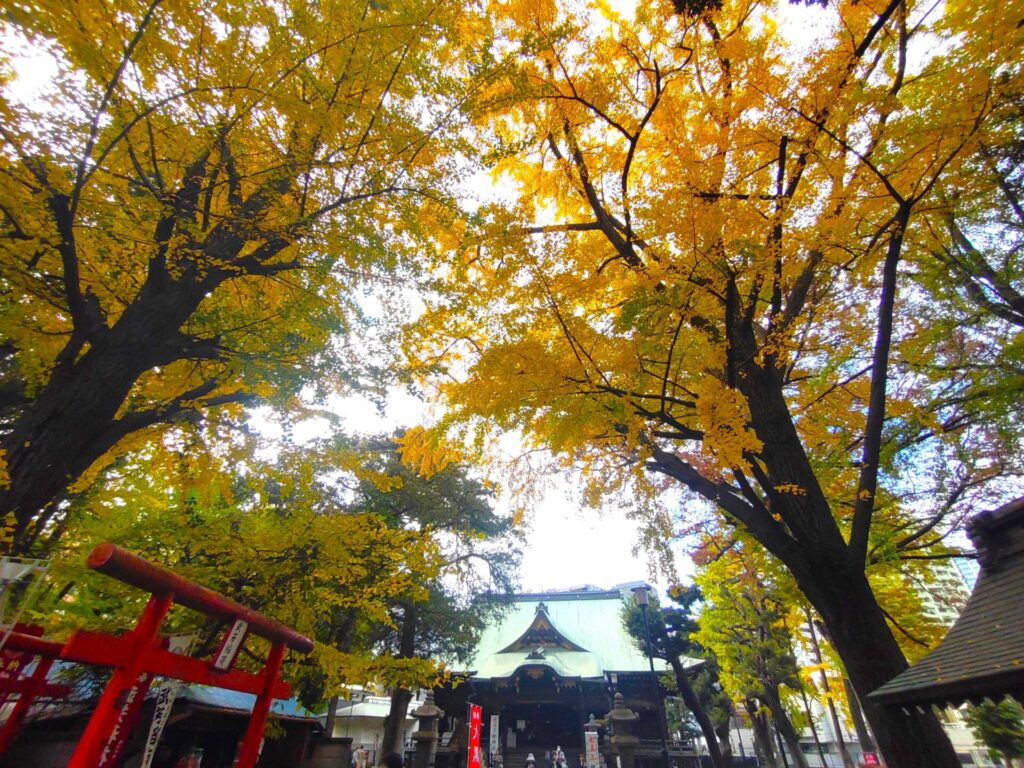
During autumn, the entire complex becomes beautifully dyed in a rich ginkgo-yellow hue. Planning your visit to coincide with the peak autumn foliage season is highly recommended.
【The Guardian Deity of the Land: Takeyoshi Inari Daimyojin】
The exact founding year of Takeyoshi Inari Daimyojin remains shrouded in mystery.
![20260616 133204399 1024x768 - Zoshigaya Kishimojin-do Temple [Tokyo]](https://japan-shrine.info/wp-content/uploads/20260616_133204399-1024x768.jpg "Zoshigaya Kishimojin-do Temple [Tokyo]")
In ancient times, this entire region was covered by a dense, dark forest affectionately known as the “Forest of Inari.” Records indicate that a small wooden shrine box (hokora) already existed here during the Koji era (1555–1558). When the main temple halls were constructed later on, this shrine was carefully preserved within the precincts as the Jishin (the territorial guardian deity of the soil) and has been cherished ever since.
![DSC 0511 1024x768 - Zoshigaya Kishimojin-do Temple [Tokyo]](https://japan-shrine.info/wp-content/uploads/DSC_0511-1024x768.jpg "Zoshigaya Kishimojin-do Temple [Tokyo]")
While it originally stood as an incredibly modest wooden shrine box measuring less than one tsubo (about 3.3 square meters), the current magnificent worship structure was erected in 1967 (Showa 42). Furthermore, a tunnel pathway of 25 vibrant vermilion torii gates was dedicated in 1971 (Showa 46), followed by a pair of sacred fox statues (Komakitsune) at the front in 1974 (Showa 49), culminating in the fantastical, mystical sight visitors see today.
The enshrined deity is Ukanomitama no Mikoto.
【Precincts Shrine: Hokushin Myoken Dai-Bosatsu】
Directly behind the main sanctuary sits the small shrine dedicated to Hokushin Myoken Dai-Bosatsu.
![20260616 134115331 1024x768 - Zoshigaya Kishimojin-do Temple [Tokyo]](https://japan-shrine.info/wp-content/uploads/20260616_134115331-1024x768.jpg "Zoshigaya Kishimojin-do Temple [Tokyo]")
The Myoken-do hall is constructed in a perfect “back-to-back” alignment with the main hall. Because Myoken Dai-Bosatsu is the cosmic deity of the North Star who governs the northern skies, the hall is deliberately oriented to face precisely due “North (the northern heavens).” It stands as a precious piece of architecture where you can physically experience the ancient, meticulous attention given to directional alignments when positioning Shinto and Buddhist deities.
Because the name Myoken translates literally to “seeing beautifully/clearly,” this Buddha has also been widely celebrated since antiquity as a compassionate guardian who protects eyesight and cures eye diseases.
【Precincts Shrine: Nori Fudo-do】
The Nori Fudo-do hall stands quietly and independently on the far left edge of the grounds as you enter from the main approach. It enshrines Kongo Fudo-son as its principal image.
![20260616 133806485 1024x768 - Zoshigaya Kishimojin-do Temple [Tokyo]](https://japan-shrine.info/wp-content/uploads/20260616_133806485-1024x768.jpg "Zoshigaya Kishimojin-do Temple [Tokyo]")
Within the Nichiren Sect, there is a fascinating history of incorporating Fudo Myoo (Acala) by interpreting him as “a benevolent deity who fiercely guards the teachings (Nori / Law) of the Lotus Sutra.” For this reason, he is deeply revered and affectionately called “Nori Fudo,” carrying the spiritual meaning of “The Fudo Deity who Protects the Buddha-Law and the Lotus Sutra.”
【The Strength Stones and the Tea Kettle】
![20260616 133834389 1024x768 - Zoshigaya Kishimojin-do Temple [Tokyo]](https://japan-shrine.info/wp-content/uploads/20260616_133834389-1024x768.jpg "Zoshigaya Kishimojin-do Temple [Tokyo]")
Preserved within the precincts are seven Chikaraishi (Strength Stones) bearing chiseled inscriptions, alongside several unmarked boulders. The engraved characters record the names of “strong local youths” or “professional sumo wrestlers” who successfully managed to hoist the heavy stones back in the day, along with the precise weight of the rocks (measured in old units like kan).
![20260616 133852263 1024x768 - Zoshigaya Kishimojin-do Temple [Tokyo]](https://japan-shrine.info/wp-content/uploads/20260616_133852263-1024x768.jpg "Zoshigaya Kishimojin-do Temple [Tokyo]")
Sitting directly adjacent to these strength stones is a vintage cast-iron tea kettle. In 1958 (Showa 33), a stone monument called the “Doshin-hi” (Child’s Heart Monument) was erected here to honor individuals who contributed significantly to the development of children’s literature in Japan (such as Ashiya Shigetoki). This tea kettle was installed alongside the monument to serve as an icon for classic fairy tales loved by youth, perfectly matching Kishimojin’s role as a divine guardian for child-rearing and healthy youth development.
【The Old-Fashioned Sweet Shop: Kamikawaguchi-ya】
![DSC 0515 1024x768 - Zoshigaya Kishimojin-do Temple [Tokyo]](https://japan-shrine.info/wp-content/uploads/DSC_0515-1024x768.jpg "Zoshigaya Kishimojin-do Temple [Tokyo]")
Kamikawaguchi-ya is celebrated as the oldest operating traditional sweet shop (Dagashi-ya) in all of Japan, boasting a founding date of 1781 (Tenmei元). It is a tiny shop tucked away under the canopy of the shrine grounds, having continuously operated in this exact same location from the Edo period to the modern day. It is also widely famous for serving as the real-life model for the nostalgic sweet shop featured in the Studio Ghibli animated film Only Yesterday (Omohide Poro Poro).
【Goshuin】
![kishimojin 733x1024 - Zoshigaya Kishimojin-do Temple [Tokyo]](https://japan-shrine.info/wp-content/uploads/kishimojin-733x1024.jpg "Zoshigaya Kishimojin-do Temple [Tokyo]")
【Nearby Tourist Spots (Within a 30-Minute Walk)】
Otori Shrine, Mejiro Garden, Ikebukuro Station, Sunshine City, Gokokuji Temple, Hotel Chinzanso Tokyo, St. Mary’s Cathedral (Tokyo Cathedral), Higo-Hosokawa Garden
![20260616 131645132 520x300 - Zoshigaya Kishimojin-do Temple [Tokyo]](https://japan-shrine.info/wp-content/uploads/20260616_131645132-520x300.jpg "Zoshigaya Kishimojin-do Temple [Tokyo]")
![DSC 1558 520x300 - Zoshigaya Kishimojin-do Temple [Tokyo]](https://japan-shrine.info/wp-content/uploads/DSC_1558-520x300.jpg "Zoshigaya Kishimojin-do Temple [Tokyo]")
![DSC 1218 520x300 - Zoshigaya Kishimojin-do Temple [Tokyo]](https://japan-shrine.info/wp-content/uploads/DSC_1218-520x300.jpg "Zoshigaya Kishimojin-do Temple [Tokyo]")
![DSC 0454 1 520x300 - Zoshigaya Kishimojin-do Temple [Tokyo]](https://japan-shrine.info/wp-content/uploads/DSC_0454-1-520x300.jpg "Zoshigaya Kishimojin-do Temple [Tokyo]")
![DSC 1257 520x300 - Zoshigaya Kishimojin-do Temple [Tokyo]](https://japan-shrine.info/wp-content/uploads/DSC_1257-520x300.jpg "Zoshigaya Kishimojin-do Temple [Tokyo]")
![DSC 1265 520x300 - Zoshigaya Kishimojin-do Temple [Tokyo]](https://japan-shrine.info/wp-content/uploads/DSC_1265-520x300.jpg "Zoshigaya Kishimojin-do Temple [Tokyo]")
【Recommended Walking Route Including Zoshigaya Kishimojin-do】
The walking routes and itineraries have been compiled below for your reference, and I hope they prove useful for your travels.
![shinjuku ikebukuro route1 520x300 - Zoshigaya Kishimojin-do Temple [Tokyo]](https://japan-shrine.info/wp-content/uploads/shinjuku-ikebukuro-route1-520x300.jpg "Zoshigaya Kishimojin-do Temple [Tokyo]")
【Zoshigaya Kishimojin-do Temple Access】
Admin’s Impressions
When I visited this temple in the past, the entire complex was dyed in a breathtaking shade of golden yellow, but coming here during the summer offers a completely different, refreshing expression. The elegant, graceful atmosphere of the autumn is spectacular, so I highly recommend planning a trip around then. When you make your pilgrimage to Kishimojin-do, one spot you absolutely must check out as a set package is the “Myoken-do” hall nestled directly behind the main sanctuary, which houses “Hokushin Myoken Dai-Bosatsu.” In a total reversal from the lively, bustling atmosphere of the front gate, stepping around to the rear of the main hall reveals an astonishingly quiet, solemn, and sacred atmosphere known only to those in the know. While you can easily walk here from Ikebukuro Station, my personal recommendation is to get off at Tokyo Metro Zoshigaya Station so you can approach the temple from the very front, wandering through Otori Shrine along the way.